
How to get salon clients without Instagram
Short answer: someone who needs her roots doing next week is not scrolling Instagram hoping a stylist appears. She is typing “hairdresser near me”, or “balayage” and her town, into Google at nine at night on the sofa. So the ways to reach her without posting are the ones that catch a person who is already looking: your Google listing, your reviews, the clients already in your book, and paid search if the free version is not pulling its weight.
None of that needs a reel. Most of it needs one afternoon, then almost nothing.
Why the usual advice does not help
Search for a way off social media and you get lists of social media ideas. Forty-five posts to try. A guide to Reels. It answers a question you did not ask, because whoever wrote it assumed the problem was that you had not tried hard enough, rather than that you have already decided.
Here is the more useful way to think about it. Instagram is a shop window. It is good at keeping people who already know you interested. It is poor at putting you in front of a stranger at the moment she decides she needs a colour, because she is not looking for you there. Those are two different jobs, and you only have to do the second one to fill a Tuesday.
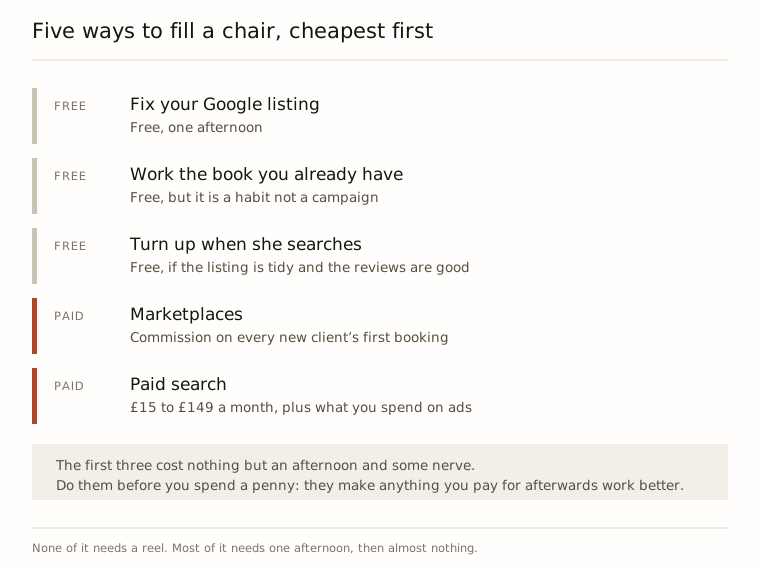
1. Fix your Google listing first
Free, one afternoon, and it is the thing most salons have left half done.
Your Google Business Profile is what appears in the map results when someone searches for a hairdresser in your town. Go through it properly:
- Every service listed by name, the way a client says it. Balayage, root tint, keratin, not “colour services”.
- Correct opening hours, including the days you are shut. A wrong Sunday costs you a walk-in and then a one-star review from someone who drove over.
- A booking link that goes to your own booking page.
- Photos of your actual work and your actual room. Not stock images of a woman in a white robe.
- A phone number that is answered.
Then reviews. Ask every happy client out loud, at the till, while she is still pleased with her hair. “If you have a minute, a Google review really helps us.” That is the whole script. Reviews are what a stranger reads before she rings, and they do more for a nervous first-timer than any post you could make.
This is also the part that is yours to keep. Whatever else you do or stop doing later, a tidy listing with real reviews carries on working.

2. Work the book you already have
Ask a room of stylists this question and the first answer is always referrals. They are right. It is also slower than people admit, so run it as a habit rather than a hope.
- Rebook her in the chair. Not “give me a text nearer the time”, the next appointment written in before she puts her coat on.
- A referral card that gives her friend something, not just you.
- A message to anyone you have not seen in four months. Not a campaign, just a text. “Hi Sam, realised it has been a while, want me to hold you a Thursday?” It is uncomfortable to send and it works.
This is the cheapest new business you will ever get. It also has a ceiling, because it grows out of the clients you already have. It cannot fill a diary that is half empty to begin with, which is why it is number two rather than the only item.
3. Turn up when she searches
Everything above is about people who already know you. This is the part that replaces what Instagram was supposed to do, and it is the bit missing from most answers to this question.
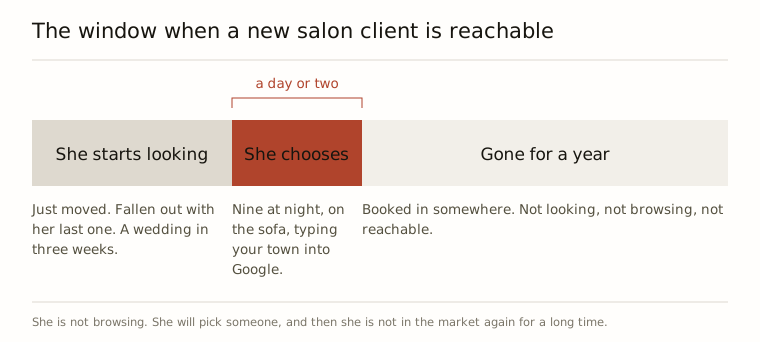
At any given moment in your town, a handful of people are actively looking for a hairdresser. They have just moved, or fallen out with their last one, or have a wedding in three weeks. They are not browsing. They will pick someone in the next day or two, and then they are gone for a year.
Those people go to Google. If your listing is tidy and your reviews are good, some of them find you for nothing. That is the free half, and for a salon in a quiet area with little competition it is sometimes enough on its own.
If it is not enough, the honest answer is that you pay to be in front of them. Which brings us to the two ways of doing that.
4. Marketplaces, and the trade you are making
Treatwell, Fresha and the rest will bring you new clients without Instagram. That is genuinely what they are for, and if you are quiet it can be worth it.
The trade is this. They charge a commission on a new client’s first booking, so the fee is an acquisition cost you pay on every new person, including the ones who never come back. And the client arrives with an app on her phone, which shows her every other salon in your town as well.
Rates and minimum fees change, so read them off Treatwell’s and Fresha’s own pricing pages before you decide, not off a comparison site. We went through the arithmetic, and what changes when you take your own bookings instead, in leaving Treatwell or Fresha to take your own bookings.
5. Paid search, if free is not enough
The other way is to buy the top of that search yourself, so you appear when someone types “hair colourist” and your town, and nothing happens when they do not.
Two warnings before you try it.
The first is Google’s own five minute setup, the one it offers you from inside your Business Profile. It is free to switch on and it will spend your budget on people searching for hairdressing courses, apprenticeships, jobs and free model nights. Those clicks cost the same as a real one. We block 536 of those searches before a first click is paid for, and that list is most of the difference between an ad budget working and an ad budget disappearing.
The second is that this is not for everyone. If you are already fully booked, do not do it. If you could not take fifteen more clients next month, do not do it. If you are hovering under the VAT threshold and crossing it would cost you more than the extra work brings in, do not do it. And if you have less than about £100 a month to spend, the numbers do not work and we will tell you so.
If you are past all of those, this is what we do: one campaign split by service, a landing page, the time-wasting searches blocked, checked every week, and four numbers and one email a month so you can see what happened. £15 to £149 a month depending on how much you spend on ads, no commission on bookings ever, fourteen days free, cancel in one click.
Rachel Hartley at The Lockhouse spends £300 a month with us. She says: “I’d tried boosting posts and it got me students. This got me eight colour clients in the first month and I didn’t touch a thing after signing up.”
A month’s report looks like this: 38 calls, 21 enquiries, £300 spent, £14 per enquiry. What we cannot tell you is which client came from which search, because the booking systems do not share that back. We count calls, form enquiries and clicks through to your booking page, and we say so rather than dressing it up.
There is more on whether the sums work for a small salon in are Google Ads worth it for a small salon.
Do this week
- Open your Google Business Profile and fix the services, hours, booking link and photos.
- Ask your next ten clients for a review, out loud, at the till.
- Rebook every client in the chair for a fortnight and see what it does to the following month.
- Text everyone you have not seen since April.
- Only then decide whether you need to pay for anything.
Steps one to four cost nothing but an afternoon and some nerve. Do them before you spend a penny, because they make everything you might pay for afterwards work better.
One last thing about Instagram
Do not delete the account. You do not have to post, but leave the profile up with a few recent photos, your address and how to book.
People check. She finds you on Google, likes the reviews, then taps through to see whether you are real and whether you can do her hair. A profile that has been quiet for three months is fine. A profile that has vanished makes her wonder if you have closed.
Stopping the treadmill and closing the shop window are not the same decision. You only need to make the first one.
If you want to know what your own local search actually looks like, the free assessment takes about forty seconds and gives you your numbers and the faults on your Google listing before you have an account or a card.
Questions people ask
Do I need a website for any of this to work?
Not for the free parts. A tidy Google listing with a booking link does that job on its own. Paid clicks are different: sending them to an Instagram profile wastes them, so they need somewhere with your services, your area and a button. We write and host that page if you have not got one.
How do I ask for reviews without breaking Google's rules?
Ask everybody, and ask out loud at the till. What is not allowed is paying for reviews, offering a discount in exchange, or only asking the clients you expect to be kind. Share your review link freely and take whatever comes back.
What if I work mobile, or rent a chair inside someone else's salon?
You can still be found. Google lets a business list the area it serves instead of an address people visit, which is the setting most mobile stylists and chair renters need. Everything else on this page works the same way, because the search is local either way.
Someone else is bidding on my salon's name. Can they do that?
Usually yes, and it is common. The defence is cheap rather than legal: your own name is the one search where your ad and your page are the most relevant result there is, so it costs very little to sit above them on it.
What do I do about a bad review?
Reply once, calmly, in public. You are not writing to the person who left it, you are writing to the next reader deciding whether to ring you. Genuine reviews cannot be removed, and a salon with nothing but five stars reads as staged anyway.