
How to get more curly hair clients
When a woman with curly hair goes looking for someone who knows curls, the search she types says so: curly hair salon, curly cut, curly hair specialist, often with a town on the end. She is not after the nearest salon, and that makes her easier to reach than most new clients. Getting more curly clients comes down to three things: a page on your own website about your curly cuts, curls named on your Google listing and, if you have the budget, a small ad on those exact searches.
Two stylists asked the same thing this month
On Reddit’s r/hairstylist at the start of October, a stylist about a year and a half in, still assisting, asked how to become a curl specialist when the salon she works in does not get those clients. A fortnight later another stylist asked much the same in Dutch, hoping one day to open a small salon at home.
If you are still assisting, be straight with yourself: there is nothing to advertise yet. An ad sends a stranger to a page, and that page needs your own curly work on it, on clients who agreed to the photos, with a price and a way to book. Build that first. The rest of this is for the stylist, renter or owner who already cuts curls and wants more of them in the column.
What page one shows when she searches for curls
We pulled the UK results Ahrefs had recorded for three searches today, 27 October, and sorted the eight ordinary listings on each page one by who owned them. The map and the other boxes Google adds are left out.
For hairdresser near me, five of the eight were booking or review sites: Booksy, Treatwell, Yelp and two Fresha pages. One was a chain. Two were independent salons’ own websites.
For curly hair salon near me, six of the eight were independent salons’ own sites. One was a curly stylist’s Instagram profile and one was a list article about London’s curly salons. Not one booking site.
For curly hair specialist, seven of the eight were salons’ own pages, and the eighth was that same Instagram profile.
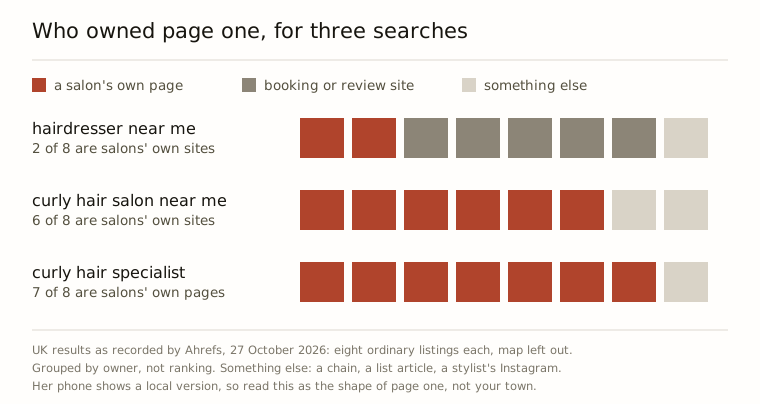
Several of those salon sites are tiny by Ahrefs’ measure. One Edinburgh salon’s curly page sat at number four for curly hair specialist with no other website linking to it at all. That is not a promise you will do the same. Ahrefs keeps one version of the results for the whole UK, and the phone in her hand shows a version for where she is standing, with a map on top. What it does show is the shape: on the general search the booking sites have page one sewn up, and on the curly searches Google shows plain salon pages about curls.

Write one page about your curly cuts
That page is what most of those results have in common. One page, about curls, in one town. Put on it:
- what you actually do with curly hair, in plain words, and the names of any methods you genuinely use
- how long a first curly appointment takes, and a from price
- how you want her to arrive, if it matters to how you cut
- your own photos of curly clients who said yes to being photographed
- your town in the page title, and one clear way to book
Leave the rest of your menu off it. Cuts, colour and blow-dries live on the rest of your site. This page answers one woman’s one question, which is whether you know what you are doing with hair like hers. It is the same idea as the one-service page in our piece on extension clients, and the same split we went through for colour clients.
Put curls on your Google listing
Your Google Business Profile has a services list. Google’s help page on services, read today, says you can choose from suggested services or create custom ones, and add a description and a price to each. So add your curly cut as a service of its own, with a sentence on what it involves and the price in the price field. Not in the name: the same page says custom services with prices or phone numbers in the name are rejected automatically.
Then the business description. Google’s guidelines for representing your business, read today, say to use it for useful information on the services and products you offer. A line saying you cut curly hair, and how, belongs there. The same guidelines rule out promotions, prices and links of any kind in the description, so keep it to what you do.
If you rent a chair and your listing is complicated by working at someone else’s address, that has its own piece.
How many curly clients fill a curl day
Before you spend anything, work out how many curly regulars you are actually short. These are made-up round numbers, so put your own in. Say you want one curl day a week with four curly appointments in it, and your curly clients come back every twelve weeks. Four slots a week, each regular coming once every twelve weeks, takes 48 regulars to keep that day full.
Say you have 12 curly regulars now. That is roughly one of the four slots filled each week, and you are 36 short. If three new curly clients a month come back for a second cut, 36 divided by three is twelve months to fill the day.
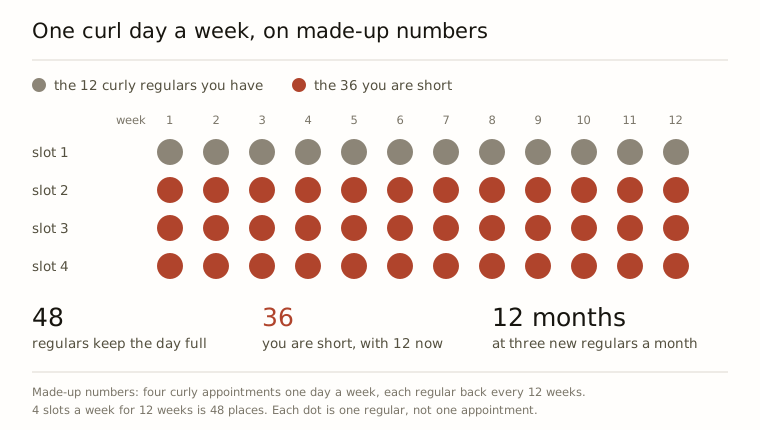
That number tells you how big the job is. Thirty-six over a year is three a month, which is the size of thing a small ad can be asked to help with. If the sum says you are four short, a page and a tidied listing may be enough on their own, and you keep your money.
A small ad on the exact search
If you do advertise, the curly searches want their own corner of the campaign: their own ad group, their own ad, and your curl page as the place the ad sends her. Keywords in phrase or exact match, built on the words she types: curly hair salon, curly cut, curly hair specialist, curly hairdresser, with your town or near me on the end.
Then the searches to keep out. Plenty of people type curly hair wanting a product or a routine, not an appointment. Start with negative keywords like products, shampoo, routine, course and training, and read your search terms for the first fortnight to see what else turns up. One catch, in Google’s words on its negative keywords page, read today: you will need to add synonyms and singular or plural versions if you want to exclude them. So product does not block products. Add both.
Two more things. Do not draw the area too tight. We cannot tell you how far a curly client will travel, because nobody has measured it for your town, but the list of London’s best curly salons that ranks for these searches is written for women prepared to look past their own street. A radius set to the next few roads saves money by hiding you from exactly those women. And keep the budget honest: a curl ad group sharing a small monthly budget with everything else gets very little each day. Our piece on £100 a month works through what a small budget buys.
If you would rather not run the ads yourself
That is what we sell: Google Ads for hair salons, barbershops and chair renters, built and run without you. One campaign split by service, so curls get their own ad group and their own words, and 536 time-wasting searches blocked before your first click, courses and DIY among them. £15 to £149 a month depending on your ad spend band, no commission on bookings ever, and your Google listing gets fixed before you pay anything. There is no free trial: your first payment is our fee plus your first month’s ad budget, and that switches the ads on. The empty chairs calculator on our homepage, the button that says What could I make?, shows what your empty chairs cost you in a year before you sign up to anything.
Two honest limits. Under about £100 a month of ad spend, we will tell you not to bother. And if your curl days are already full for the next month, do not start: an ad that fills a diary you cannot fit is money spent turning women away.
Questions people ask
Can I add curly hair specialist to my salon's name on Google?
Only if that is genuinely the name over your door. Google's guidelines for representing your business, read today, say the name on your listing should be your real-world name and must not include service information, and that adding unnecessary information can get a profile suspended. Put curls in your services and your business description instead, where Google asks for them.
Can I ask curly clients to mention curls in their Google review?
Ask for a review, but leave what she writes to her. Google's Maps content policy, read today, says businesses should not request that specific content is included in a review, and must not offer discounts, freebies or payment in exchange for one. If curls were the reason she came, she can say so in her own words.
Can I run the curly ad only on the day I cut curls?
You can, but it does not save you anything. She might search on a Sunday night for an appointment the following week, so the ad wants to be there whenever she looks. And Google's ad scheduling page, read today, says a scheduled campaign still paces toward a monthly spend of 30.4 times your average daily budget, however many days it runs.
Should a curly cut cost more than a standard cut?
Price it on the time it takes you, not on the word curly. If a first curly appointment runs longer than your standard cut, the price should say so, and a from price on your curl page means she knows before she books. Nobody wants a surprise at the till, least of all a new client.
What if the other stylists in my salon do not cut curls?
Then say who does. Your curl page, the description on your Google service and your ad should name the stylist and the days she cuts curls, and curly bookings should only go into her column. A curly client who books online and lands with someone who does not cut curls is exactly the first visit all of this is meant to avoid.
