
Research
Why UK hair and beauty industry figures disagree (2026)
Why the UK hair and beauty industry is quoted as £28.3bn, £30.4bn, £9.3bn or £6.1bn, what each one measures, and which to cite. Every figure linked and dated.
Key figures
- £28.3bn
- Whole beauty and personal care economy, total contribution to UK GDP, 2025 (includes products, retail, supply chain and wage spending)
- £5.7bn
- Beauty services (hairdressing and beauty therapies), direct contribution to UK GDP, 2025
- £9.29bn
- Household spending at hairdressing salons and personal grooming establishments, 2025
- £6.1bn
- Turnover of 50,400 VAT or PAYE registered hair and beauty businesses, as at March 2025
- About 20%
- Share of the £28.3bn headline that is beauty services (derived)
If you need one number for the size of the UK hair and beauty industry, you will find at least six in circulation, and they are not estimates of the same thing. This page lists each one, says what it actually measures, and tells you which to use for what you are writing.
Every source below was checked on 4 October 2026. Where we have done arithmetic, the sum is shown.
The figures in circulation
| Figure | What it measures | Year | Source |
|---|---|---|---|
| £30.4bn | Whole beauty and personal care economy, total GDP contribution, as first published | 2024 | British Beauty Council, Value of Beauty 2025 |
| £28.3bn | The same thing, the following year | 2025 | British Beauty Council, Value of Beauty 2026 |
| £14.4bn | The same industry, direct GDP contribution only | 2025 | Value of Beauty 2026, PDF |
| £9.29bn | What households spent at hairdressing salons and personal grooming establishments | 2025 | ONS series CCRE |
| £6.1bn | Turnover of 50,400 VAT or PAYE registered hair and beauty businesses | March 2025 | NHBF Industry Statistics 2025 |
| £5.7bn | Beauty services (hairdressing and beauty therapies), direct GDP contribution | 2025 | Value of Beauty 2026, PDF |
| £3.42bn | Turnover of the 14,480 businesses registered for VAT | 2023-24 | HMRC figures via the Sector Data Archive |
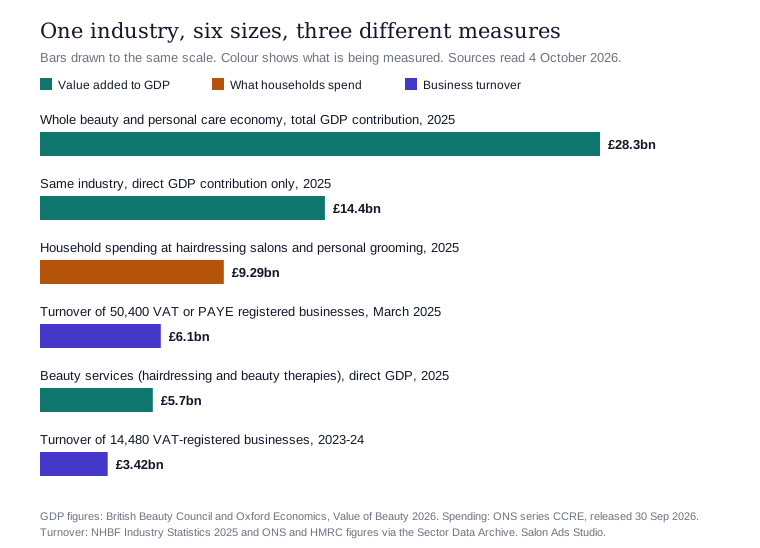
They measure three different things. Some are value added to the economy (GDP), some are what customers spend, and some are what businesses report as turnover. Those are not interchangeable, and the biggest one counts far more than salons.
Why £28.3bn is not the size of the salon trade
The British Beauty Council’s Value of Beauty 2026, compiled by Oxford Economics and published on 1 July 2026, says the sector generated £28.3bn in 2025 and supported more than 595,000 jobs. The same page says the sector spans hairdressing, beauty, wellness, aesthetics, manufacturing, retail and marketing.
The full report breaks the £28.3bn into three parts for 2025:
- £14.4bn direct: generated by the industry itself, 0.5% of the UK economy by the report’s own reckoning.
- £6.1bn indirect: supported by the industry’s purchases from its UK supply chain.
- £7.8bn induced: supported when the industry’s workers, and its suppliers’ workers, spend their wages.
So nearly half of the headline is activity in other industries. And the direct £14.4bn still includes making, wholesaling and retailing beauty products: the 2025 edition lists the beauty sub-sectors as beauty services, retail of beauty goods, wholesale of beauty goods and manufacturing of beauty goods.
The part that is salons, in the report’s words, is beauty services such as hairdressing: £5.7bn of direct GDP contribution in 2025, the largest of the beauty sub-sectors. The Council’s own launch post describes that slice as hairdressing and beauty therapies.
About 20% of the headline is beauty services. Derived: £5.7bn ÷ £28.3bn = 20.1%, both figures from Value of Beauty 2026, year 2025. Against the direct figure alone it is 40% (£5.7bn ÷ £14.4bn = 39.6%).
The jobs figure works the same way. Of the 595,000 jobs, the report says 422,000 were direct and 243,000 of those were in beauty services in 2025.
If an article says “the UK salon industry is worth £28.3bn”, it is quoting Value of Beauty 2026 on the whole beauty and personal care economy, products and supply chain included, as if it were salons.
Why £30.4bn became £28.3bn
The £30.4bn figure is still widely repeated. The Council’s own SIC codes announcement of 24 March 2026 says the industry contributes £30.4bn to UK GDP, approximately 1.1% of the total.
It comes from the previous edition. Value of Beauty 2025 put 2024 at £30.4bn in total, of which £15.9bn was direct.
The 2026 edition then restated 2024. A footnote in Value of Beauty 2026 says that, using the latest ONS data, the industry’s direct contribution in 2024 was £14.4bn, with 431,200 jobs, reflecting updates to official household spending data.
So most of the drop from £30.4bn (2025 edition) to £28.3bn (2026 edition) is a change in the estimate, not a change in the industry:
- 2024 direct contribution, restated down by £1.5bn (9.4%). Derived: £15.9bn (2025 edition) minus £14.4bn (2026 edition footnote) = £1.5bn; £1.5bn ÷ £15.9bn = 9.4%.
- 2024 direct jobs, restated down by 64,800 (13.1%). Derived: 496,000 in the 2025 edition minus 431,200 in the 2026 edition footnote = 64,800; 64,800 ÷ 496,000 = 13.1%.
- 2024 total, restated to about £28.4bn. Derived: the 2026 edition says the 2025 total of £28.3bn was a 0.4% decrease on 2024, so 2024 is implied at £28.3bn ÷ 0.996 = £28.4bn. That makes about £2.0bn of the £2.1bn gap a restatement, and about £0.1bn the actual change between years. Both inputs are rounded, so treat this as approximate.
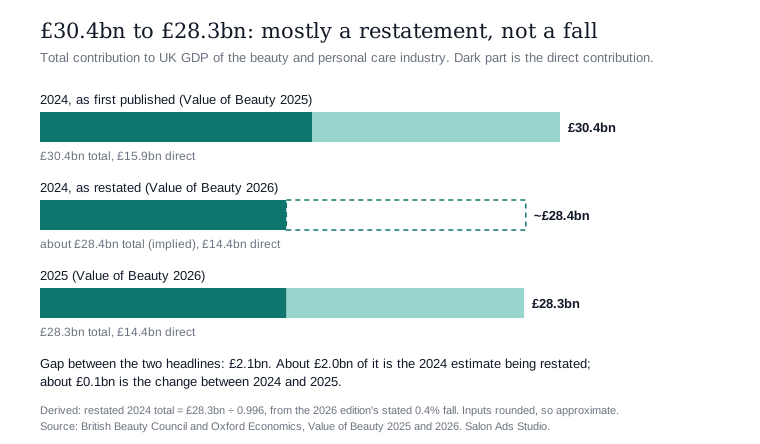
One more inconsistency worth knowing: the report gives 0.4% as the fall in the total and 0.2% as the fall in the direct contribution, while the Council’s launch post attaches the 0.2% to the £28.3bn total. Quote the report.
Three sizes on one homepage
On 4 October 2026 the British Beauty Council’s homepage carried three different figures for the same industry:
- £28.3bn, in the panel for the Value of Beauty 2026 report.
- “close to 28.4Bn to UK GDP”, in a panel about how the Council works with government. That matches the restated 2024 total derived above, though the page does not say which year it means.
- £16.4B as the “contribution made to total UK GDP”, in a counter alongside “1%” share of GDP, 495K jobs and 91K businesses. The counter carries no year and no source.
None of this is a criticism of the report. It is what happens when a headline is updated annually and older copies stay live. It is why a figure should always be quoted with its year and a link to the report it came from.
What clients spend
The Office for National Statistics publishes what UK households spend at hairdressing salons and personal grooming establishments as series CCRE. In the release of 30 September 2026 it reads £9,289m for 2025, down from £9,576m in 2024. Current prices, seasonally adjusted. The next release is due 22 December 2026.
Household spending fell 3.0% in 2025. Derived: £9,289m minus £9,576m = minus £287m; £287m ÷ £9,576m = 3.0%, both from ONS series CCRE, not adjusted for inflation. The first half of 2026 is running at the same pace: £4,587m against £4,731m in the first half of 2025 (quarters summed from the same series), also 3.0% lower.
This is the closest published figure to “what clients pay salons”, tips and VAT included, because it is measured from the spending side. It also covers grooming establishments that are not hair salons, so it is a little wider than hairdressing alone.
The Sector Data Archive, updated 27 August 2026, quotes £10.26bn for 2025 from the same ONS category. The ONS file as released on 30 September 2026 reads £9,289m. We could not establish whether that gap is a revision or a different calculation, so we quote ONS directly and suggest you do too.
The £28.3bn headline is about three times what households spent at salons and grooming establishments. Derived: £28.3bn (Value of Beauty 2026) ÷ £9.289bn (ONS CCRE) = 3.0, both for 2025. One is value added across a whole economy, the other is spending at one kind of business, so this is a sense of scale, not a like-for-like ratio.
What registered businesses turn over
The NHBF Industry Statistics 2025 summary, read on 4 October 2026, gives 50,400 hair, barbering and beauty businesses registered for VAT and/or PAYE, around £6.1bn in turnover, 81% employing fewer than five people and 64% turning over less than £100,000. The NHBF’s 2024 summary on the same page gives £5.8bn for 2023-24.
The underlying ONS extract is reproduced in the Sector Data Archive: £6,103,278,000 of turnover across 50,400 businesses in SIC 2007 class 96.02, as at March 2025, up from £5.79bn and 49,320 businesses a year earlier. The archive repeats the ONS warning that these turnover values come from sources ONS cannot verify.
The narrowest figure is the HMRC data in the same archive: £3.42bn of turnover from the 14,480 businesses registered for VAT in 2023-24, down from 14,900 the year before. These are the businesses above the £90,000 threshold. The rest of the registered trade sits below it, and the self-employed who are registered for neither VAT nor PAYE are in none of the business figures.
This is the figure family our UK salon marketing statistics reference builds on, and it is the one that describes salons and barbers as businesses.
Which number to cite
- Writing about salons, barbers and beauty businesses as businesses (start-ups, lending, insurance, average turnover): use £6.1bn turnover across 50,400 registered businesses, March 2025, from the NHBF 2025 summary, and say it excludes unregistered self-employed workers.
- Writing about what customers spend: use £9.29bn in 2025 from ONS series CCRE, and say it includes personal grooming establishments.
- Writing about salons’ place in the economy: use £5.7bn direct GDP contribution from beauty services in 2025 from Value of Beauty 2026.
- Writing about the whole beauty economy, products included: use £28.3bn in 2025 from Value of Beauty 2026, and do not call it the salon industry.
- £30.4bn: do not use it as a current figure. It is the 2025 edition’s estimate for 2024, which the 2026 edition has since restated.
For what a salon spends to win clients, and what the average salon turns over, see the hub page: UK salon marketing statistics 2026.
Method
Every source was opened on 4 October 2026. The Value of Beauty 2026 report page offers the PDF to members only, but the same PDF is linked openly from the British Beauty Council homepage, and that is the copy we read. The copy our tools returned had been retrieved on 20 September 2026; its headline figures (£28.3bn, £8.8bn in tax, 595,000 jobs) match the report page as read on 4 October 2026. The ONS figures were read from the CSV download of series CCRE as released on 30 September 2026. The NHBF figures were read from the summary text on the NHBF statistics page, not from its member-only full report.
Derived figures on this page, all from figures linked above:
- Beauty services share of the headline, from Value of Beauty 2026: £5.7bn ÷ £28.3bn = 20.1%; of the direct figure, £5.7bn ÷ £14.4bn = 39.6%. Year 2025.
- 2024 direct contribution restated: £15.9bn minus £14.4bn = £1.5bn; ÷ £15.9bn = 9.4%.
- 2024 direct jobs restated: 496,000 minus 431,200 = 64,800; ÷ 496,000 = 13.1%.
- 2024 total implied by the 2026 edition: £28.3bn ÷ (1 minus 0.004) = £28.41bn, shown as about £28.4bn. Inputs are rounded to one decimal place, so the split of the £2.1bn gap into £2.0bn restatement and £0.1bn change is approximate.
- Household spending change: (£9,289m minus £9,576m) ÷ £9,576m = minus 3.0%. First half: (£4,587m minus £4,731m) ÷ £4,731m = minus 3.0%. Cash terms.
- Headline against household spending: £28.3bn ÷ £9.289bn = 3.05, shown as about three times.
We have not mixed measures inside any sum except the last one, which is labelled as a scale comparison only. GDP contribution is value added, which is turnover minus what a business buys in, so it should not be compared directly with turnover or spending.
These figures are all published by others. No account data of ours can measure the size of an industry, so instead of being replaced by our own data, this page will be re-derived when each source publishes its next edition: ONS series CCRE next on 22 December 2026, and the Value of Beauty and NHBF statistics annually.
Sources
- 1. British Beauty Council, The Value of Beauty 2026 (report page, published 1 July 2026) Read 2026-10-04
- 2. British Beauty Council and Oxford Economics, Value of Beauty 2026 (PDF, linked from the Council's homepage) Read 2026-10-04
- 3. British Beauty Council and Oxford Economics, Value of Beauty 2025 (PDF) Read 2026-10-04
- 4. British Beauty Council, Value of Beauty 2026 launch news post (1 July 2026) Read 2026-10-04
- 5. British Beauty Council, new SIC codes announcement (24 March 2026) Read 2026-10-04
- 6. British Beauty Council, homepage Read 2026-10-04
- 7. ONS, Consumer trends series CCRE, 12.1.1 Hairdressing salons and personal grooming establishments, current prices, seasonally adjusted (released 30 September 2026) Read 2026-10-04
- 8. NHBF, Industry Statistics (2024 and 2025 summaries) Read 2026-10-04
- 9. UK Hair and Beauty Sector Data Archive, Business and Economic Data (ONS and HMRC figures, updated 27 August 2026) Read 2026-10-04
Cite this page
Free to quote with a link back. Figures were last checked on 4 October 2026.
Salon Ads Studio, "Why UK hair and beauty industry figures disagree (2026)", 2026. https://salonadsstudio.com/research/why-uk-hair-and-beauty-industry-figures-disagree-2026/
A plain-text version for AI tools and reference managers: /research/why-uk-hair-and-beauty-industry-figures-disagree-2026.md
