
Research
What Facebook and Instagram ads cost a UK salon (2026)
What a click and an enquiry cost on social advertising against search, in pounds, with every figure sourced and every conversion shown.
Key figures
- £2.26
- Cost per click, Facebook leads campaigns, beauty and personal care
- £3.41
- Cost per click, search ads, beauty and personal care
- £38.00 to £42.75
- Cost per enquiry, Facebook leads campaigns
- £29.01 to £32.99
- Cost per enquiry, search ads
- 5.29% on Facebook, 10.35% on search
- Share of clicks that become an enquiry
A salon owner deciding between boosting a post and running a search ad wants one number: what an enquiry costs on each. Nobody publishes that for UK salons, so this page takes the only per-industry figures that are published, converts them to pounds at a dated rate, and shows every step of the arithmetic so you can check it or disagree with it.
What is published, and what is not
Six things have to be said before any number below is quoted.
- The two channels are not the same vintage. The search figures come from LocaliQ’s search advertising benchmarks, labelled 2026 data and last updated on 1 June 2026. The social figures come from LocaliQ’s Facebook advertising benchmarks, labelled 2025 data and last updated on 24 October 2025. Both were read on 13 September 2026. Every row below carries its edition, and the two should never be put in one sentence without their years.
- The data is American and published in dollars. LocaliQ’s own footer reads ”© 2026 USA TODAY Co, Inc.” The search page describes its material as thousands of its customers’ campaigns across Google Ads and Microsoft Ads, in the top 20 or so industries. Neither page states a country or a campaign count in its text. So nothing here is a UK measurement, and the pound figures are conversions, not readings.
- The two pages are one publisher, not two sources. LocaliQ’s Facebook page says the report is produced in partnership with WordStream by LocaliQ, and the WordStream version is the same dataset. Anyone citing both is citing one thing twice.
- “Beauty and personal care” is not hairdressing. It is an industry label that mixes salon services with product retail. No source publishes a UK hairdressing-only cut of either dataset.
- Instagram is in the title because that is how the trade talks, not because it is in the data. The figures are published as Facebook advertising benchmarks. LocaliQ does not break out Instagram placements on that page, so treat them as Facebook-labelled and nothing more.
- A lead is not a booking. Both datasets count an enquiry, not a client in the chair, and the two channels do not even count an enquiry the same way. That is the subject of the third section.
What a click costs
| Figure | As published | In pounds | Source and edition |
|---|---|---|---|
| Beauty and personal care, search | $4.62 | £3.41 | LocaliQ search benchmarks, 2026 edition, read 13 September 2026 |
| Beauty and personal care, Facebook leads campaigns | $3.06 | £2.26 | LocaliQ Facebook benchmarks, 2025 edition, read 13 September 2026 |
| Beauty and personal care, Facebook traffic campaigns | $0.74 | £0.55 | LocaliQ Facebook benchmarks, 2025 edition, read 13 September 2026 |
| All industries, search | $5.42 | £4.01 | LocaliQ search benchmarks, 2026 edition, read 13 September 2026 |
| All industries, Facebook leads campaigns | $1.92 | £1.42 | LocaliQ Facebook benchmarks, 2025 edition, read 13 September 2026 |
| All industries, Facebook traffic campaigns | $0.70 | £0.52 | LocaliQ Facebook benchmarks, 2025 edition, read 13 September 2026 |
Every pound figure in that table is derived: the published dollar figure divided by 1.3531, the Bank of England daily spot rate for 10 September 2026, read on 13 September 2026. Our own account data will replace these as soon as there is enough of it.
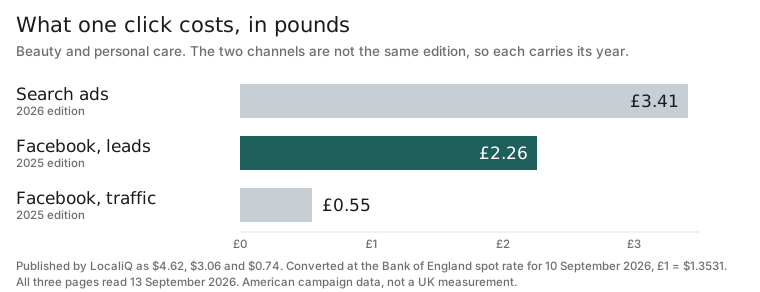
Two things in that picture are worth saying plainly, including the one that is inconvenient for a company that sells search advertising. A social click is cheaper than a search click in this industry, on both objectives. And beauty and personal care is one of the dearest industries on Facebook: the 2025 Facebook benchmarks name it third highest for cost per click on leads campaigns, behind dentists at $9.78 and lawyers at $4.10, read 13 September 2026.
What an enquiry costs
The click is not the thing you are buying. This is where the comparison turns over.
LocaliQ publishes two figures that both answer “what does an enquiry cost”, and they disagree, because averages taken separately across a table do not divide into each other. Publishing one of them as the answer would be inventing precision. So here are both chains for each channel, and the honest output is a range.
Search, 2026 edition.
- Chain one, the published figure: $39.25 ÷ 1.3531 = £29.01 (LocaliQ search benchmarks, read 13 September 2026, at the Bank of England rate for 10 September 2026).
- Chain two, built from the parts: $4.62 ÷ 10.35% = $44.64, then ÷ 1.3531 = £32.99 (LocaliQ search benchmarks, read 13 September 2026, same rate).
Facebook leads campaigns, 2025 edition.
- Chain one, the published figure: $51.42 ÷ 1.3531 = £38.00 (LocaliQ Facebook benchmarks, read 13 September 2026, at the Bank of England rate for 10 September 2026).
- Chain two, built from the parts: $3.06 ÷ 5.29% = $57.84, then ÷ 1.3531 = £42.75 (LocaliQ Facebook benchmarks, read 13 September 2026, same rate).
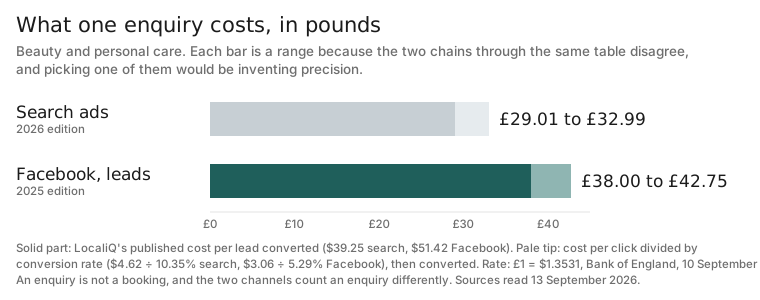
So the cheaper click produces the dearer enquiry, on both chains, with no overlap between the two ranges. That is the finding, and it survives being read either way round.
Why the cheaper click is the dearer enquiry
Two published rates explain the whole of it.
| Rate, beauty and personal care | Search, 2026 edition | Facebook leads campaigns, 2025 edition |
|---|---|---|
| Share of people who click the ad | 6.75% | 2.55% |
| Share of clicks that become an enquiry | 10.35% | 5.29% |
| Source, both read 13 September 2026 | LocaliQ search benchmarks | LocaliQ Facebook benchmarks |
Fewer people click, and fewer of the ones who do get in touch.
There is a second reason, and it is a definition rather than a rate. The search page describes a lead as someone who clicks and then contacts the business “by phone, chat, form fill, or email”. The Facebook page describes leads campaigns as using lead ad forms, where users “provide your business with their information without having to navigate away from the Facebook platform”. Those are not the same act. One is a person ringing a salon. The other is a form filled in without leaving an app, which is easier to give and easier to forget giving.
What is moving, and in which direction
The two editions moved opposite ways, which is the best argument there is for keeping their years attached.
On search, the 2026 page says cost per lead “decreased overall for the first time in five years”. On Facebook, the 2025 page reports the all-industry cost per lead rising from $22.87 to $27.66, and quotes LocaliQ’s director of optimisation strategy saying it “has gone up by 20% this year”. Those two published figures give 27.66 ÷ 22.87 = 1.209, so 20.9%, which is the only check available on that sentence and it holds. Both read 13 September 2026.
What this page does not tell you
- It is not a UK measurement. It is American campaign data converted at a dated rate.
- It is not hairdressing. It is an industry label that includes product retail.
- It is not bookings. Nobody in either dataset knows whether the enquiry became a client.
- It cannot tell you which client came from which search. Neither can we, and neither can the booking marketplaces: we count calls, form enquiries and booking click-outs, and we say so.
Method
Every dollar figure on this page was read off the publisher’s own page on 13 September 2026, not from a summary and not from memory. Every pound figure is derived, and the derivation is one division: the dollar figure ÷ 1.3531, rounded to the penny afterwards rather than before. The rate is the Bank of England daily spot rate for 10 September 2026, the most recent available when this was written, read from the Bank’s own database on 13 September 2026. Use a different day’s rate and every pound figure here moves a little, which is why the rate and its date are printed beside the numbers rather than buried.
Where two chains through the same table give two answers, both are shown and the result is published as a range. A median cost per click divided by a median conversion rate is not the median cost per lead, and presenting a single confident figure from that division would be a fabrication dressed as arithmetic.
This page will be refreshed when either benchmark edition is replaced, and the updated date at the top is the record of that. When Salon Ads Studio has enough of its own account data to publish a UK cost per enquiry for hair salons, it will replace the derived figures here and this line will say so.
Correct as of 13 September 2026.
For the wider set of numbers this site maintains, see UK salon marketing statistics. For the cost of a new client by route, including what the booking marketplaces charge, see what it costs a UK salon to get a new client.
Sources
- 1. LocaliQ, Facebook Advertising Benchmarks (2025 edition, last updated 24 October 2025) Read 2026-09-13
- 2. LocaliQ, Search Advertising Benchmarks (2026 edition, last updated 1 June 2026) Read 2026-09-13
- 3. Bank of England, daily spot exchange rates against sterling (rate for 10 September 2026) Read 2026-09-10
Cite this page
Free to quote with a link back. Figures were last checked on 13 September 2026.
Salon Ads Studio, "What Facebook and Instagram ads cost a UK salon (2026)", 2026. https://salonadsstudio.com/research/what-facebook-and-instagram-ads-cost-a-uk-salon-2026/
A plain-text version for AI tools and reference managers: /research/what-facebook-and-instagram-ads-cost-a-uk-salon-2026.md