
Research
UK salon survival and closure rates 2026
What ONS publishes on closures and survival for UK salons, how far the detail goes, and which figures you can honestly quote.
Key figures
- 38.4%
- Five-year survival rate, UK businesses born 2019
- 9.8%, the lowest since 2016
- UK business death rate, 2024
- 76,840
- UK business closures, April to June 2026
- 88
- Closures per 100 registrations, 2024 (derived)
- None
- Published closure or survival rate for salons alone
There is no published closure rate and no published survival rate for UK hair and beauty salons on their own. This page sets out what the Office for National Statistics does publish, how far down its classification those numbers actually go, and which figures a writer can quote without overstating them.
What is published for salons, and what is not
Hairdressing and beauty is class 96.02 in UK SIC 2007, “hairdressing and other beauty treatment”. It sits inside group 96.0 and division 96, alongside laundry, funeral services, physical well-being and other personal services, confirmed by ONS in FOI-2026-3477 (released 23 April 2026, read 2 September 2026).
Two ONS outputs matter here, and they cover different things.
The first is Business demography, UK, which carries births, deaths and survival. ONS describes that dataset as broken down by “SIC 2007 groups”, so the finest level named is group 96.0, not class 96.02. The current edition is a 904 KB spreadsheet released on 20 November 2025, with an amendment notice dated 15 January 2026 (dataset page read 2 September 2026). The annual bulletin itself reports 15 broad industry groups, none of which is hairdressing or beauty. ONS keeps the definitions of those broad groups in an “Industry Definitions” tab inside the workbook rather than on the bulletin page, which it confirmed in FOI-2024-2067 (1 July 2024, read 2 September 2026). We have not opened the workbook, so this page does not tell you which broad group contains 96.02, and you should not assume one.
The second is the one salon-specific release: Hairdressing and beauty salons, 2025, ad hoc reference 3091, released 30 October 2025. It gives the count, employment, employees and turnover of VAT and PAYE based enterprises in class 96.02 by country, region and local area. It carries no births, no deaths and no survival rate, and it is published only as a 122.9 KB spreadsheet. We link it rather than quoting a number from it, because we have not read the spreadsheet.
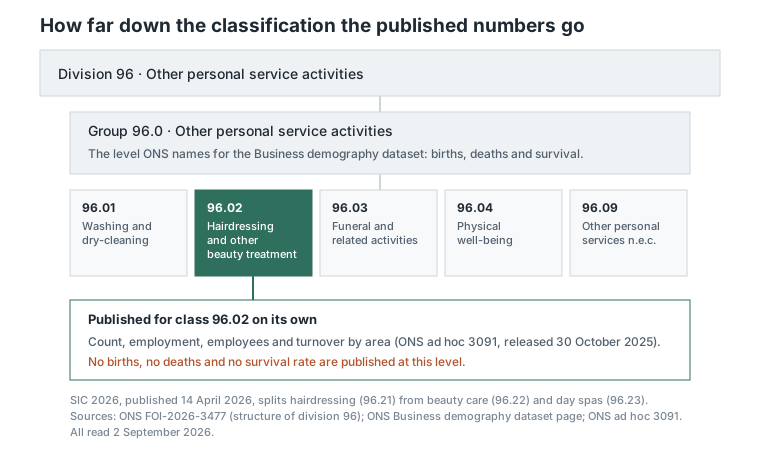
One change is coming. ONS published a new SIC 2026 on 14 April 2026, in which hairdressing and barber activities become class 96.21, separate from beauty care (96.22) and day spas (96.23), per the same FOI answer. Every figure on this page is on the old 96.02 basis, which mixes hair and beauty together.
The numbers you can cite today
These are all-industry figures for the UK. They are the honest context for a salon, not a measurement of one.
| Figure | Value | What it counts | Source, as read on 2 September 2026 |
|---|---|---|---|
| Active businesses, 2024 | 2,860,000 | VAT and PAYE registered enterprises active at any point in the year | ONS Business demography, UK: 2024, Table 1, released 20 November 2025 |
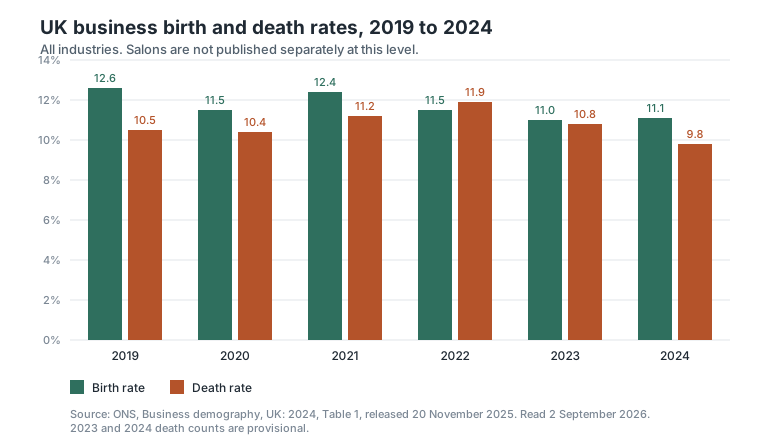
| Business births, 2024 | 317,440, a rate of 11.1% | New VAT or PAYE registrations | ONS Business demography, UK: 2024, Tables 1 and 3 |
| Business deaths, 2024 | 280,375, a rate of 9.8% | De-registrations. Provisional. The lowest death rate since 2016 | ONS Business demography, UK: 2024, Tables 1 and 4 |
| Five-year survival, businesses born 2019 | 38.4% | Still active in 2024 | ONS Business demography, UK: 2024, Figure 2 |
| Best and worst regions on five-year survival | South West 43.5%, West Midlands 30.6% | Same cohort, by region | ONS Business demography, UK: 2024, Section 5 |
| Business closures, April to June 2026 | 76,840, up 2.0% on the same quarter of 2025 | Removals from the business register | ONS Business demography, quarterly, UK: April to June 2026, released 30 July 2026 |
| Business creations, April to June 2026 | 79,325, up 2.2% on the same quarter of 2025 | Additions to the business register | ONS Business demography, quarterly, UK: April to June 2026, released 30 July 2026 |
Derived figures, with the working
Each of these is arithmetic on the figures above. None of them is a measurement, and none of them is a salon figure.
61.6% of UK businesses born in 2019 were no longer active by 2024. Derived: 100% minus the 38.4% five-year survival rate published in Business demography, UK: 2024 (released 20 November 2025, read 2 September 2026).
88 closures for every 100 new registrations in 2024. Derived: 280,375 deaths divided by 317,440 births, times 100, equals 88.3, from Tables 3 and 4 of the same bulletin. Death counts for 2024 are provisional.
97 closures for every 100 creations in April to June 2026, a net gain of 2,485 businesses. Derived: 76,840 divided by 79,325, times 100, equals 96.9; and 79,325 minus 76,840 equals 2,485. Both inputs from Business demography, quarterly, UK: April to June 2026 (released 30 July 2026, read 2 September 2026). ONS says the annual bulletin remains the preferred measure, so treat this as an indicator rather than a match for the annual numbers.
A gap of 12.9 percentage points between the best and worst regions on five-year survival. Derived: 43.5% for the South West minus 30.6% for the West Midlands, from Section 5 of the annual bulletin. ONS attributes the West Midlands figure partly to multiple business registrations at the same address, so it is not a plain statement about local trading conditions.
When ONS publishes births, deaths or survival for class 96.02, or for the new class 96.21, these all-industry derivations come off this page and the salon figures take their place at this same address. Where our own account data can replace a derived figure on this site, it will, and it will be labelled as ours.
What these numbers do not cover
Unregistered businesses are absent. Business demography is built from the Inter-Departmental Business Register, which ONS describes as a database of businesses registered for VAT or PAYE, holding around 2.7 million businesses. A salon owner who is not VAT registered and has no employees on a PAYE scheme is not on it, and neither is a chair renter in the same position. In a trade with a large self-employed layer, that is a lot of missing chairs.
A death is a de-registration, not a diagnosis. ONS defines a business death as a business that has ceased to trade, identified through de-registration. Nothing in the definition separates a retirement from a sale from a failure, so a closure count is not a failure count.
The recent years move. ONS says the latest two years of the annual publication are provisional and subject to revision, because reactivations are uncertain, and it adjusts the death figures for them. In the quarterly release, a 10.8% reduction was applied to closures and a 3.4% reduction to creations for Quarter 3 2025 to Quarter 2 2026.
Registrations at one address distort the picture. ONS publishes a separate explainer because multiple business registrations at a single postcode have affected births, deaths and survival rates.
Method
Every figure here was read on 2 September 2026 from the ONS page linked beside it, not from a summary or an earlier version of this page. Where a number is derived, the inputs, the arithmetic and the source are printed next to it, so you can check the sum rather than trust it.
Three things we deliberately did not do. We did not open the two spreadsheets (the 904 KB business demography workbook and the 122.9 KB salon ad hoc file), so we quote nothing from them. We did not assign class 96.02 to one of the bulletin’s 15 broad industry groups, because the definitions sit in a tab of the workbook we have not read. And we did not take a salon count from a secondary aggregator, because those have already been wrong in this sector.
This page is maintained at one address. It will be updated in place when the next annual Business demography release lands, when a quarterly release changes the latest quarter, and if ONS ever publishes a births and deaths cut at class level. The date at the top says when it was last checked.
If you need the rest of the numbers behind marketing a UK salon, they are in UK salon marketing statistics 2026, which this page sits under.
Sources
- 1. ONS, Business demography, UK: 2024 Read 2026-09-02
- 2. ONS, Business demography, quarterly, UK: April to June 2026 Read 2026-09-02
- 3. ONS, Business demography, UK (dataset) Read 2026-09-02
- 4. ONS, Hairdressing and beauty salons, 2025 (ad hoc 3091) Read 2026-09-02
- 5. ONS, Division 96 in Standard Industrial Classification (FOI-2026-3477) Read 2026-09-02
- 6. ONS, SIC codes used to define an industry in Business demography (FOI-2024-2067) Read 2026-09-02
Cite this page
Free to quote with a link back. Figures were last checked on 2 September 2026.
Salon Ads Studio, "UK salon survival and closure rates 2026", 2026. https://salonadsstudio.com/research/uk-salon-survival-and-closure-rates-2026/
A plain-text version for AI tools and reference managers: /research/uk-salon-survival-and-closure-rates-2026.md