
Why your salon bookings dropped this month
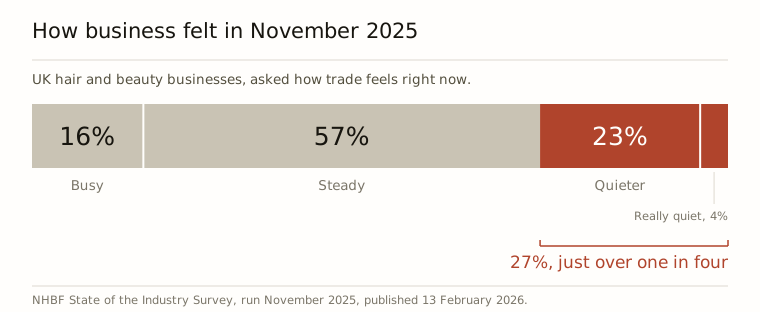
Some of it is probably not you, and some of it probably is. The last NHBF State of the Industry survey, run in November 2025 and published in February 2026, asked hair and beauty businesses how trade felt. 16% said busy, 57% said steady, 23% said quieter and 4% said really quiet. Add the last two together and you get 27%, just over one in four. So the slowdown is real, and it is also a minority. It will not, on its own, explain a book that has fallen off a cliff. Here is how to work out which part of this is yours, from numbers you already have, in about twenty minutes.
Do this before you change anything
Do not compare this month with last month. Compare it with the same month last year.
August against July tells you that people go away in August. It feels like a trend and it is a calendar. The comparison that means something is this month against the same month a year ago, and the year before that if you have it.
Then split it into two numbers, because they are two different problems with two different answers.
- Returning clients. People already on your list who came in this month.
- New clients. People who had never sat in your chair before.
Most booking systems will give you both in a couple of taps. If yours will not, count the new names in the book.
Now read the result.
- Returning down, new steady. Nothing is wrong with how people find you. Something has changed in how often your regulars come back, and the section after next is about exactly that.
- New down, returning steady. The problem is upstream of your chair. People who have never met you are not finding you.
- Both down. Start with the new clients. Your regulars know where you are. A stranger who cannot find you never knew you existed.
That is the whole diagnosis, and everything below hangs off which of the three you have just landed on.
What the rest of the country is saying
The same survey asked whether the work was covering the bills. 6% were making a good profit, 30% a small profit, 45% were just breaking even, 15% were making a small loss every month and 4% a substantial one.
Read the two sets of numbers together, because they say something more useful than either does alone. Most of the sector is still trading steadily. What has gone is the headroom. The NHBF put it plainly in the same write-up: many businesses are still trading, but too many are doing so without the financial headroom to cope with the pressures being placed on them.
That distinction decides what you do next week. A demand problem is fixed by more clients. A margin problem is not, and filling the book at a discount makes it worse. If your chairs are reasonably full and the money still is not there, more bookings is the wrong lever.
The drop that is not people leaving
The NHBF’s summary of what its members tell them is worth reading twice: clients are still coming, but often stretching appointments out, limiting extras and thinking twice before committing to higher-frequency services.
That is the quiet nobody sees arriving, because nobody leaves.
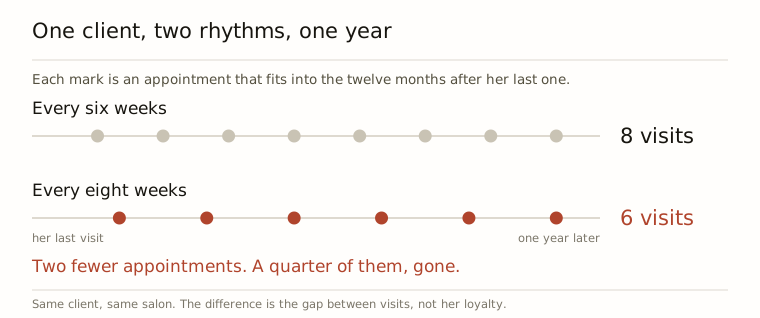
Take one client who has always come in every six weeks. Counting from her last appointment, she fits eight visits into the next twelve months. Move her to every eight weeks and she fits six. Two fewer, a quarter of them, and she will tell you nothing has changed, because from where she is sitting nothing has. She has not gone to the salon down the road. She washed her fringe herself and pushed it a fortnight.
Do that to a third of your regulars and you have a midweek that looks abandoned and a client list that looks perfectly healthy.
The good news is that this one is findable tonight. Your booking system knows when each client last came in and roughly how often she used to. Pull the list of people whose usual gap has already gone past. That is not a campaign. It is a list of names, and it is the cheapest thing on this page.

Three things that break without telling you
If new clients are the number that dropped, something between a stranger and your front door has stopped working. Three candidates, in the order they are worth checking.
Your Google listing. Google is blunt about the basics: to show your business on Search, Maps and other Google services you have to add or claim it, then verify it. After that, the details drift. Christmas hours set as special hours and never taken off. A phone number that rings a mobile you stopped carrying. A category that says barber when you are a colour salon. Open your listing on your own phone, signed out, and read it the way a stranger would. When you do change something, Google reviews your changes before it updates them live, so make the edit and come back to it.
Your ads, if you run any. An ad account can read healthy in every column and still barely show. There is a whole piece on that here: why your salon ads are not showing at all. Worth ruling out before you give up a Saturday to anything else.
The rebooking habit at the desk. This is the one that goes quiet when you are busy and never comes back on its own. If nobody is asking about the same time in six weeks while the card machine is still in her hand, the gap gets set by whenever she next thinks of you, and that is precisely the stretch above.
What not to do in the first fortnight
Do not cut your prices across the board. The first people through the door at the lower price are the ones who were already coming at the higher one, so the discount lands mostly on the clients you never had to convince. If you are going to discount at all, aim it at the empty hours rather than the full ones. A Tuesday at two is worth less to you than a Saturday at eleven, and your pricing is allowed to say so.
And do not spend money before you have done the twenty minute check at the top of this page. Spending on new clients when the drop was in returning clients is money aimed at the wrong half of the problem, and it is the most common way a quiet month becomes a quiet quarter.

Where we come in
If it is the new client number that has gone, that is the part we do. We build and run Google Ads for hair salons, barbershops and chair renters: ten minutes of your time at the start and then nothing. One campaign split by service, 536 time-wasting searches blocked before your first click (courses, jobs, apprenticeships, free models), and four numbers and one email a month.
It is £15 to £149 a month depending on your ad spend band. No commission on bookings, ever. 14 days free, cancel in one click. Your Google listing gets looked at and fixed before we take a card.
And the honest part: if you are spending under about £100 a month on ads, or local demand where you are is thin, we will say so and turn you down. There is no sense taking £15 a month off you to run something that cannot work.
Rachel Hartley at The Lockhouse, on £300 a month: “I’d tried boosting posts and it got me students. This got me eight colour clients in the first month and I didn’t touch a thing after signing up.”
The free assessment takes about forty seconds and gives you your local search numbers and the faults on your Google listing, before you have an account or a card. If what it tells you is that demand where you are is fine and your problem is the gaps between visits, that is worth knowing too, and it costs nothing to find out.
Questions people ask
Someone changed my opening hours on Google and it was not me. How is that possible?
Google lets anyone who does not own or manage a profile suggest an edit to it, so a passing customer can propose a change to your hours or details. Sign in, read your listing the way a stranger would, and correct anything wrong. Google reviews your changes before it updates them live, so check back rather than assuming it saved.
I moved the salon to new premises last year. Could that still be affecting me?
It can. Google says that if you move your business to a new address after it has been verified, you must verify it again, and that changing your business name after verification might mean verifying again too. If either happened and the verification was never finished, fix that before you spend anything on ads.
My Saturdays are still full but midweek is dead. Is that the same problem?
Usually not. A full Saturday and an empty Tuesday is a shape problem rather than a demand one, because Saturdays sell themselves and midweek has to be asked for. Look at whether your quiet hours are priced, offered or promoted any differently at all. In most salons they are treated exactly like the busy ones.
Do I have to spend more to fix a quiet month?
Not necessarily, and sometimes you should not spend at all. Our fee is £15 to £149 a month depending on the ad spend band you are in, with 14 days free and one click to cancel. But under about £100 a month of ad spend, or where local demand is thin, we say no rather than take the money.
Will you be able to tell me which client came from which search?
No, and nobody honestly can. The booking platforms do not share their booking data back, so what we count is calls, form enquiries and clicks through to your booking link. That tells you whether people are finding you and getting in touch. It does not tie a named client in your chair to a search.