
What a new client should actually cost you
Nobody can give you one right number, and anybody who gives you one without asking about your book is guessing. What a new client should cost you is set by two things you already own: what a first visit leaves you after product and time, and how many first-timers come back for a second.
Almost everything written about this is American, in dollars, and buried in acronyms. Here it is in pounds and people.
What a first visit actually leaves you
Take the service a new client is most likely to book first. Not your best colour job, the one a stranger picks. Take off the product, the hour of chair time, and whatever you would pay someone else to do it.
What is left is your ceiling for visit one. It is the number that decides whether a £30 fee to get somebody through the door is a bargain or a bad month, and it takes ten minutes to work out.
Do it before you talk to anybody selling you clients. It changes the conversation.

The number nobody can give you
Here is the half nobody sells you: how many of them come back.
A barber posted this on Reddit last week. He had been in the shop 25 days and had cut about 150 people. Two of them came back.
I’ve cut about 150 people so far and 2 of them came back
He works out the likely reason himself further down the post. The shop is in a shopping centre, and the people in his chair mostly happened to be walking past once.
That is what a new client costs, said properly. A hundred and fifty first visits, two of which were worth anything after the day they happened. Look only at the price per new client and you can pay a perfectly fair rate for a client base that never turns up again.
Nobody publishes an honest UK figure for the share of new salon clients who come back, and the ones quoted around the web are American and third hand. Yours is in your own book.
What a marketplace charges for one
The marketplaces put a price on a new client in public, which makes them a useful yardstick even if you never use one.
Treatwell’s pricing page, read on 2 September 2026, says it charges 35% commission on first bookings made by new clients it brings you from the marketplace, 0% commission on repeat bookings, and a 2.5% processing fee on online prepayments, with all commissions and fees subject to VAT.
Fresha’s pricing page, read the same day, lists a one-time 20% commission on brand new clients who discover you through the Fresha marketplace, nothing on returning clients, and nothing on people who find you through your own website, Google or social media.
So on a £70 first appointment, Treatwell’s 35% is £24.50, and with VAT on top of that the fee is £29.40. Fresha’s 20% is £14.
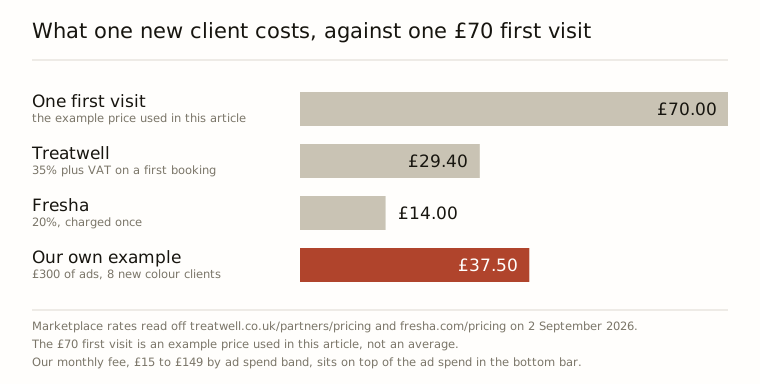
Both are exactly what they say they are: a finder’s fee, charged once, on a client who is then yours. What matters for your sum is when it is charged. You pay on the day she sits down, long before anyone knows whether she is one of the hundred and forty-eight or one of the two.
What an advert charges for one
An advert charges differently. You pay for the click, not the client, so the price of a new client moves with how good the searches are and how well the phone gets answered.
Here is ours, in full, because it is all we have. One month, as the product reports it: £300 spent, 38 calls, 21 enquiries, £14 an enquiry. And Rachel Hartley at The Lockhouse, on £300 a month, said this:
I’d tried boosting posts and it got me students. This got me eight colour clients in the first month and I didn’t touch a thing after signing up.
Eight new colour clients for £300 of ad spend is £37.50 each, with our monthly fee on top of that.
One salon, one month. That is not a promise and we are not going to dress it up as one. What it is useful for is the size of the number: a new client for an independent salon costs tens of pounds, not hundreds. If somebody quotes you a figure a long way outside that, ask what it is based on.
So what should a new client cost?
Put the two halves together and the answer stops being a price and becomes a shape.
A client who comes every eight weeks and stays a year sits in your chair six times. At £70 that is £420 of work off one finder’s fee. The same fee spent on somebody who never returns bought £70 once, and you did the work for it.
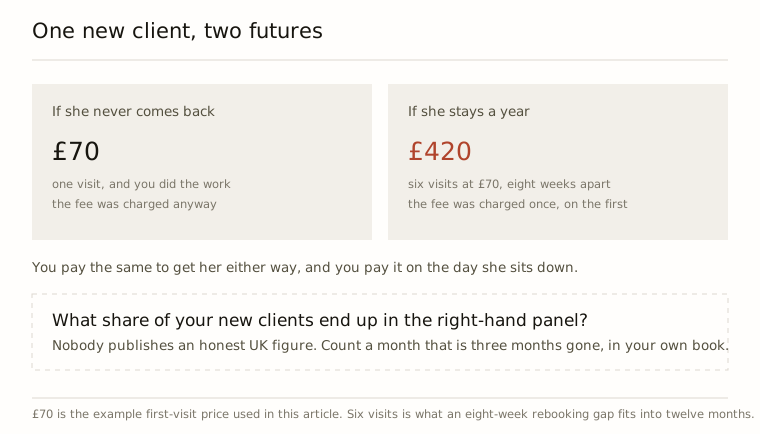
So the ceiling is not the first visit. It is what a client is worth across the visits she actually makes, multiplied by the share of them who make any, and neither of those numbers is on a pricing page or in an agency’s deck. They are in your diary.
If you want one plain rule to argue with: paying more for a new client than a first visit leaves you is only sensible if enough of them come back, and you cannot claim that until you have counted it.
How to work out your own number this month
Four steps, and none of them needs software.
- Take the price of the service new people book first. Take off product and the hour. That is your ceiling for visit one.
- Count the visits a regular makes in a year on your own rebooking gap. Six weeks fits eight into the next twelve months, eight weeks fits six.
- Pick a month that is three months gone. Count the new faces in it, then count how many you have seen since. That fraction is yours, not an average off an American blog.
- Multiply the second by the third, times your price. That is what a new client is worth to you, and the most you can sensibly pay for one.
Then hold it against what you are paying now, whether that is a commission, a retainer or a month of boosted posts.
If you want the free half first: our assessment gives you what people near you are actually searching for and what is wrong with your Google listing, in about forty seconds, before there is an account or a card involved.
Fee figures correct as of 2 September 2026, read off each company’s own pricing page on the day.
Questions people ask
Does a marketplace start charging again if a client comes back after a long gap?
Treatwell's own pricing page says 0% commission on repeat bookings and puts no time limit on that, and Fresha's says returning clients are free. Both read on 2 September 2026. If a long gap matters to your sums, get the answer in writing from the platform rather than from a comparison site.
What about a cheap service, like a £15 dry cut?
Fresha's pricing page lists a minimum fee per new client alongside the 20%, and the page served to us on 2 September 2026 quoted that minimum in US dollars. Check the figure in your own currency before you rely on the percentage: on a cheap service a minimum bites harder than a percentage does.
Should a no-show count as a client I paid for?
Yes. You paid to get her, whatever she did next. Count what you actually spent against the people who actually sat down, not against the enquiries. It makes your number look worse than the version in anyone's sales deck, and it is the only one you can plan a month with.
How do I know which client came from which advert?
You do not, and anybody who promises otherwise is selling something. A click and a booking taken in your chair are not tied to each other. What can honestly be counted is calls, form enquiries and click-outs to your booking page, so that is what we count and we say so.