
Should a salon advertise near the VAT threshold?

Short answer: if you have decided to keep your salon under the VAT threshold, do not pay to bring in more clients. Every booking an ad brings you moves you towards the line you are trying to stay behind, so you would be spending money to buy the thing you are avoiding. We turn salons in that position away ourselves. Near the threshold, advertising only makes sense in two cases: you have real room underneath it, or you have decided to go over properly. That decision belongs with your accountant, and it comes before any ad.
The threshold is £90,000 of taxable turnover over any rolling 12 months. That is what HMRC’s own Register for VAT page says, read today, and the figure has applied since 1 April 2024. Before that it was £85,000, and plenty of pages online still quote the old number, so check the date on anything you read.
This is not a tax article. We are not accountants and nothing here is tax advice. It is about the one decision that is ours to talk about: whether to spend money on ads.
The salon owner who was told to stop taking clients
In 2017 a salon owner started a thread on Salon Geek, the UK trade forum, called “The dreaded VAT threshold!”. She had just had to register. Her accountant, she wrote, kept telling her to “not go over, cut days and hours down, don’t take anymore clients on”. Her answer to that is the question this whole article is about: “What is the point of having a business and not growing it??”
The threshold was lower then, but nothing else in her post has dated. Her biggest costs, rent and wages, carried no VAT she could claim back. And she felt she could not put her prices up while the salons around her were not registered.
Another owner in the same thread had been through it and had already reached the answer: “we couldn’t creep over, we had to fly over.” That line is the whole sum, and it is worth doing once with numbers.

Why creeping over costs more than it earns
VAT is not charged on the slice above £90,000. Once you are registered, it is charged on every bill, not just the ones above the line. GOV.UK gives the standard rate as 20%, for most goods and services. If your prices stay where they are, that means a sixth of everything a client pays you becomes VAT.
Here is the sum with made-up round numbers. Assume a full year registered, prices unchanged and nothing claimed back:
- Take just under £90,000 and you keep just under £90,000.
- Take £96,000 and £16,000 of it is VAT. You keep £80,000. That is £6,000 more work and £10,000 less in your pocket.
- Take £108,000 and £18,000 of it is VAT. You keep £90,000, which is where you started, with £18,000 more work done.
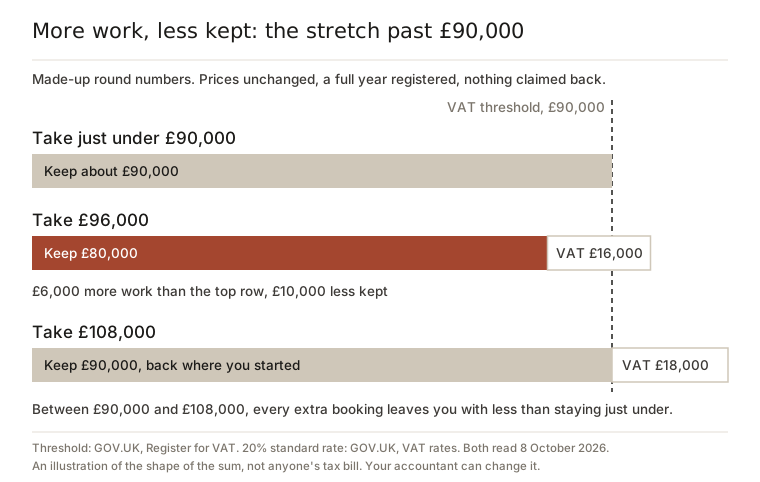
That stretch between £90,000 and £108,000 is what the owner on Salon Geek meant. Creep into it and every extra booking leaves you worse off than you were just under the line. Fly over it and you come out the other side.
Your accountant can change this sum. VAT you can claim back on products and equipment, schemes meant for smaller businesses and what you do with your prices all move it, and only they can tell you your real number. What does not change is the shape: once you are registered, the cost lands on all of your takings, not just the extra.
Three places you can be, and what an ad does in each
You are staying under on purpose. Then do not advertise for more clients. An ad has nothing to do here except push you towards the line. If the real problem is that you work too hard for what you keep, an ad cannot fix that. Hours, prices and costs can, and those are a conversation with your accountant. Keep the money. This is one of the few kinds of salon we turn away before taking a penny.
You have real room underneath. Work out how much. It is £90,000 minus what you took in the last 12 months. Say you took £72,000: that is £18,000 of room. At an average bill of £60, that is 300 more visits over a year, or 25 a month.
Then count in visits, not new clients, because a new regular is not one visit. Someone who comes in every eight weeks visits six or seven times a year, so those 300 visits are roughly 46 regulars, not 300 new faces. Do the same sum with your own room and your own average bill. If the answer is a handful of regulars, you are closer than it feels, and any ad you run needs a ceiling as well as a target. If it is dozens, the threshold is not your problem yet.
You have decided to go over. Then go over properly, which means getting through the stretch in the chart quickly rather than living in it for a year. This is where advertising earns its keep, and what you advertise matters more than how much. Crossing that same £18,000 stretch at £60 a visit takes 300 visits. At £120 a visit it takes 150. The services you put money behind decide how many extra hours it costs you to get through, and for most salons that points at colour. There is more on that in getting more colour clients instead of just cuts.
And if you are not sure which of the three you are, treat yourself as the first one for now. A month of not advertising costs you nothing while you decide, and the ads will still be there when you have.

What we do
Salon Ads Studio will not take on a salon that is managing its turnover under the VAT threshold. That is not a sales line. Bringing you clients you have decided not to want would cost you twice, once for us and once for the ads.
If you have room, or you have made the decision to go over, we run Google Ads for salons with one campaign split by service, so the money can go behind the work you would rather be doing. We charge £15 to £149 a month depending on your ad spend, and no commission on bookings, ever. If you want to know what a new client should cost before you spend anything, start with what a new client should actually cost you.
Or start with the free assessment. It works out what your empty chairs cost you in a year, and roughly how many new clients a monthly budget could bring in, before you have an account or hand over a card.
Questions people ask
What if one unusually busy month pushes me over?
HMRC's own guidance says you can apply for a registration exception if your taxable turnover goes over the threshold only temporarily. HMRC considers it and writes to tell you, and if the answer is no, it registers you. Whether your busy spell counts as temporary is a question for your accountant before you apply.
How long do I have to register once I have gone over?
HMRC's guidance says you must register within 30 days of the end of the month in which your rolling 12-month turnover went over, and the registration takes effect from the first day of the second month after that. Register late and HMRC says you owe VAT on sales from the date you should have registered, and may owe a penalty.
Do product sales count towards the threshold, or only services?
Both. HMRC defines taxable turnover as the total value of everything you sell that is not VAT exempt or out of scope, so the shampoo and styling products you sell over the counter count alongside cuts and colour. If retail is a growing part of your takings, it is moving you towards the line too.
Can I turn my ads down rather than off while I decide?
Yes. Google's help page on budgets says you can change a campaign's average daily budget at any time and as many times as you like, and if you think in monthly figures, it says to divide by 30.4. Turning the budget down is a reasonable middle step while you talk it through with your accountant.
