
Should a salon advertise in December or save for January?

For most salons, save it. If your December books itself, money spent on ads in the first three weeks of the month mostly buys clicks from people you cannot fit in, or from clients who were coming anyway. Turn the ads down, or off, for the weeks that are full, and put that money behind the weeks that actually have gaps. For most salons that means January.
That is the general answer. Yours is in your diary, and it takes five minutes to check. Here is how, and how to make the move in Google Ads without losing anything.
Why a full December is a bad thing to buy
Lockhart Meyer, a UK salon marketing firm, says it plainly in its own Christmas guide: “Most hair and beauty businesses are booked solid in December so filling empty columns is not your focus.” The same guide lists “booking clients in for the quiet new year months” as one of the month’s goals.
We agree, and the reason is how search ads charge. You pay when someone clicks, not when someone books. In a month where the diary is already full, that click can be a stranger who rings, hears the first free slot is in January, and books somewhere else. You paid for that phone call. Nobody sat in your chair.
Then there are the people who would have found you anyway. If your ads show when someone types your salon’s name, some of December’s clicks are regulars looking up your number. Paying for those is paying for bookings that were already yours.
Count the gaps, not the month
“December is busy” is a feeling. What decides this is a number you already have: how many empty appointments there are in the diary, week by week.
Open your booking system and count the empty slots you would actually want filled. Leave out the fifteen minutes between clients. Count the hour and a half at 2pm on a Tuesday that could take a colour.
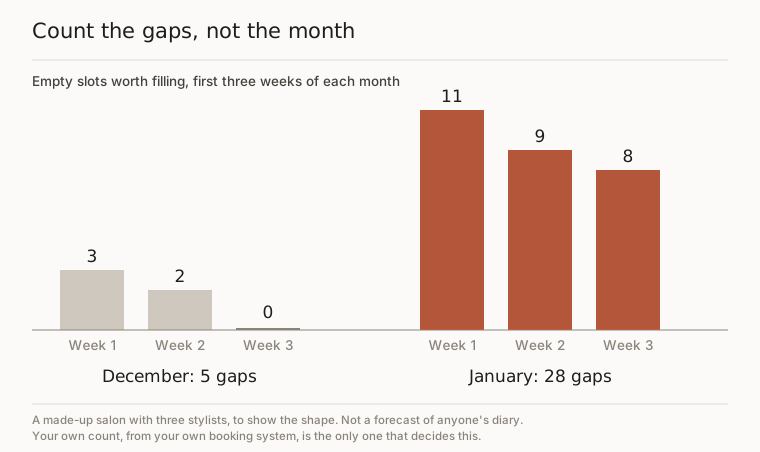
Do it for the first three weeks of December and the first three weeks of January. Here is a made-up salon with three stylists, so you can see the shape:
- December: 3 gaps in the first week, 2 in the second, none in the third. 5 in all.
- January: 11 gaps in the first week, 9 in the second, 8 in the third. 28 in all.
Now put the money against it. Say this salon spends £150 a month on ads and leaves it alone all winter. In December, £150 is chasing 5 empty slots, so there is £30 of advertising behind each one. In January the same £150 is spread across 28, about £5.36 each. That is not what a new client costs. It is just where the money is pointed, and here it is pointed the wrong way round.
If your count comes out like that, save the money. If December has as many gaps as January, the answer flips, and there is a section on that further down.
How to move the money in Google Ads
Google Ads runs on an average daily budget. Google’s own billing help says a campaign “might spend up to twice your average daily budget” on a given day, and that by the end of the month you will have spent no more than 30.4 times the daily figure. So moving money from one month to the next is just a matter of changing that daily figure.
For the made-up salon, keeping the same £300 across the two months:
- As usual: £150 in December and £150 in January. That is £4.93 a day all the way through.
- Moved: £50 in December, which is £1.64 a day, and £250 in January, which is £8.22 a day.
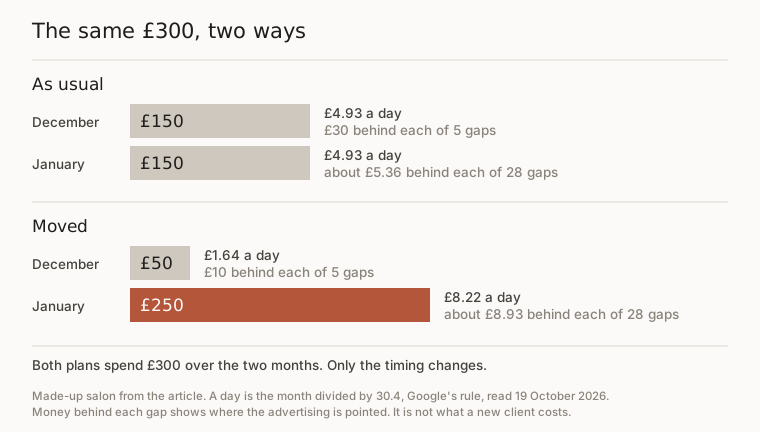
Moved, December’s 5 gaps still have £10 each behind them, and January’s 28 have about £8.93 each. Same £300. It is just spent where there is room.
One honest limit. More money in January only helps if enough people near you are searching for what you do. A bigger budget cannot make more of them. That is worth checking before you double anything.
Turn it down, or pause it?
Either is fine, as long as you do not remove it.
Google’s help page on pausing a campaign says pausing “is temporary”. It stops your ads showing and stops the charges, and “you can resume the campaign at any time and all settings and history are preserved.” Removing is permanent. A removed campaign cannot be switched back on, so you would be building it again from scratch. If you are tidying up before Christmas, pause. Never remove.
One trap on the same page: switching a campaign back on does not switch on anything you paused inside it. If you also paused single keywords or ad groups, each one has to be turned back on by hand, or the ads stay off while you think they are running.
If December is completely full, pausing for those weeks is the simplest move. If it has a handful of gaps, like the salon above, a small daily budget keeps you showing for them.

When to switch it back up
Not on the first quiet Tuesday in January. By then that Tuesday has been up for grabs for a week.
Lockhart Meyer again, writing about December: “Now is the time to be filling those January gaps in columns.” Someone who wants her colour done in the first week of January is looking before the first week of January. So put the budget back up in the days after Christmas, not after New Year, and the ad is already there when she searches.
Then point it at the gaps you counted. If January’s empty slots are midweek afternoons that suit colour, the ad should be selling colour, not the cut and blow-dry you could fill on any Saturday. We have written separately about filling the quiet midweek days and getting more colour clients.
If ads are new to you, starting in January has one more thing going for it. The first few weeks are when you find out which searches are worth paying for, and it is better to learn that with room in the diary than without. How long salon ads take to do anything covers what those weeks look like.

When December is the month to spend
Some salons count their gaps and find December is not full at all. That is the whole point of counting. It tends to be:
- a salon that opened this year and has no Christmas regulars yet
- a salon with a new stylist whose column is still empty
- a salon opening extra evenings or a Sunday before Christmas, because those slots start out empty
If that is you, advertise in December, and aim the ad at the slots you actually have. An extra Thursday evening wants an ad that says late appointments. A general ad just brings more people for the Saturdays you already filled.
The rule does not change. Put the money where the gaps are. For most salons that is January, for some it is December, and your diary knows which.
Where to start
Count your gaps this week, while there is still time to change the budget before December starts. If you do not run ads yet and want to know what January’s gaps could be worth, the free assessment works out what your quiet days cost you in a year, and roughly how many new clients a monthly budget could bring in. No account, no card.
Questions people ask
Should I put my Christmas opening hours on my Google listing?
Yes, as special hours rather than by changing your normal ones. Google's Business Profile help says special hours cover holidays and closures of up to six days in a row, and suggests confirming your hours for official holidays even when they are unchanged. If you will be closed for seven days or more, Google says to mark the business as temporarily closed instead.
Can my ads switch themselves back on after Christmas?
In a Smart campaign, yes. Google's help page lets you pause one temporarily, with a date it resumes on its own, and says that can be useful for seasonal businesses. In a standard campaign, a plain pause stays in place until someone switches it back on, so put the date in your diary the day you pause it.
Why did a Google Ads bill arrive after I paused my ads?
Usually because it covers clicks from before the pause. Google's help page on pausing a Smart campaign says a paused campaign stops running up charges, but you may still be billed for charges from while it was running. So a bill in early December can be for November. Check the dates each charge covers, and query anything dated after the pause.
Should my January ad offer a discount?
Try it at your normal prices first. A discount fills the slot with someone who came for the price, and January is when you most want clients who will come back in March at full price. If the gaps are not moving by the middle of the month, an offer on the one service with the most empty slots is a smaller step than money off everything.
