
Is there enough demand round here for another salon?

You can check before you sign, and it takes about an hour.
Google will tell you roughly how many people in a town type your services into its search box in an average month. You can run the same check on the town you work in now and compare the two. That will not tell you whether the salon will work. It will tell you whether the demand you are betting on is actually there, which is more than most people know when they put their name on a lease.
Here is how to do it, and, more to the point, what the number does and does not mean.
The question nobody asks before signing
Most site-hunting advice is about the lease, the rent, the parking and the footfall. Fair enough. But the thing that decides whether you fill the chairs in year one is whether anyone near that unit is looking for what you sell, and that is the one part almost everybody decides by eye.
“There does not seem to be another full-service salon very close by” is a sentence, not evidence. It might be the best reason to open. It might be the reason nobody has.

The tool, and what it costs to look
The tool is Keyword Planner, and it sits inside a Google Ads account under the Tools menu. Two ways in: Discover new keywords, if you want Google to suggest terms, and Get search volume and forecasts, if you already have a list.
One thing to know before you start. Google’s own page says you must complete your account setup by entering your billing information to access basic features like “Get ideas for new keywords”. So the account has to be a real one with a card on it, even though you are only going in to read numbers.
After that, two settings do all the work. Put your services in the keyword box, in the words a client would use rather than the words on your price list: balayage, root touch up, hair extensions, blow dry, men’s cut. Put the place in the location box instead of in the keyword. Google says that box takes countries, territories, regions and cities, and there is a Nearby button that suggests places around the one you entered.
Do it twice. Once for the town with the empty unit in it, once for the town you already work in. The second number is your control, because you know what your current town supports. You are living in it.
What that number is actually counting
This is where it goes wrong for most people, and it matters, because a number you misread is worse than no number at all.
Google defines average monthly searches as the average number of times people have searched for a keyword and its close variants, based on the month range, location and Search Network settings you chose. By default it is averaged over twelve months.
Unpack that and you get four things:
- It counts searches, not people. One woman choosing a new colourist might search five times in a fortnight.
- It is a twelve-month average, so the dead January and the December rush are both folded into it.
- It includes close variants, so it covers a family of phrases rather than the exact words you typed.
- It is rounded. Google says so, and adds that when you pull ideas for several locations the volumes might not add up as you would expect.
So treat it as a ranging shot, not a survey. A town with roughly double another town’s number is meaningfully busier. Two numbers within a rounding of each other are the same number.
How small an area you can ask about
“Round here” means something much smaller to you than it does to Google, and there are two separate floors underneath it.
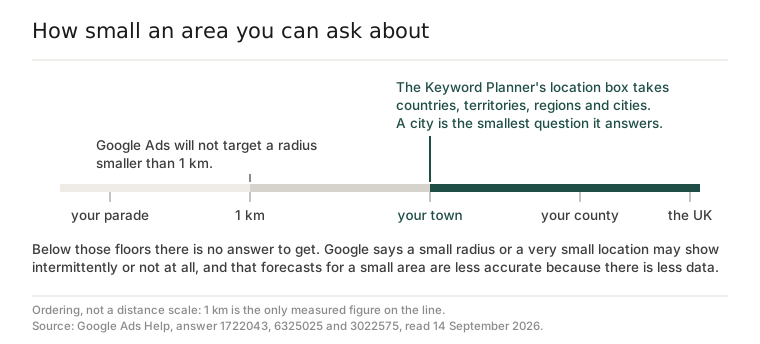
The planner’s location box stops at a city. It will not answer for your parade, your postcode, or the half mile people would realistically walk.
And when you get as far as advertising, Google’s floor is published: radius targeting requires setting a radius of at least 1 km around any given location. It warns twice about going small. If you target a small radius or a very small location, your ads might only show intermittently or not at all, because small targets might not meet its targeting criteria. And forecasts for a small geographic region are less accurate, in Google’s own words, simply because there is less data on which to base predictions.
One more line worth having in your head before you decide an area is dead: keywords with very low search volumes are not discoverable or forecastable at all. An empty result can mean almost nobody is searching. It can also mean you typed a phrase real people do not use. Try it three different ways before you believe it.
From a search to somebody in your chair
Here is where the confidence should come off, and where most of the people selling you a location report will keep theirs on.
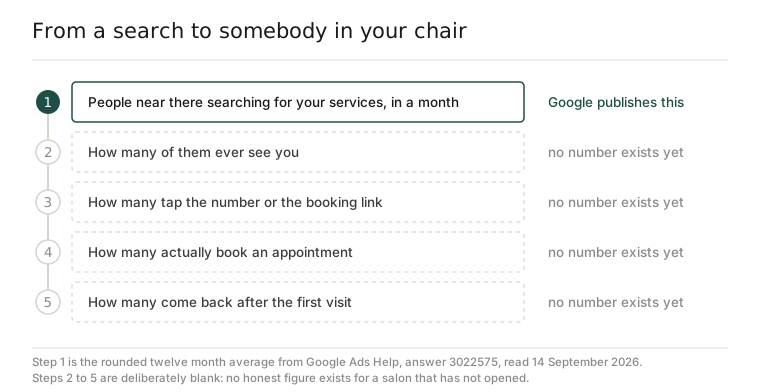
Only the first link has a number anybody can look up. For a salon that does not exist yet, nobody can honestly give you the other four, and any projected new clients per month that lands in your inbox is arithmetic performed on somebody’s assumptions.
We will not hand you those numbers either. Once a salon is live we count calls, form enquiries and booking click-outs, and we never claim to know which client came from which search, because from our side that is not knowable.

Counting what is already there
Two more checks, both free, neither of them a number Google hands you.
Open Maps, search hairdressers and barbers around the postcode, and count the pins inside the area you would realistically serve. Write the number down. Then go and stand on the street twice: a Tuesday at eleven and a Saturday at half ten. A parade that is dead midweek is showing you what your own quiet days will look like.
While you are there, read the price lists in the windows. A street of £28 cuts and a street with three colour specialists at £120 are two different markets, and only one of them will pay for the work you want to be doing.
One warning on the way back. Do not read the planner’s Competition column as competition from salons. Google defines it as the number of advertisers that showed on each keyword relative to all keywords across Google, rated low, medium or high for the location and network you chose. That is a count of people bidding, not of people cutting hair. A town can hold nine salons and still read low, because eight of them have never run an ad. That is a point in your favour, not against.

If the number comes back small
Small is not the same as nothing, and on its own it is not a reason to walk away.
Plenty of full books were built on the school gates, the street and twenty years of word of mouth, in towns where hardly anybody searches for anything. What a small number tells you is narrower and more useful than that: paid search will not be the thing that fills your opening months, so do not sign a lease whose rent depends on it doing that.
It is also where we say no. We turn away salons with thin local demand, and anyone who cannot put about £100 a month behind the ads, and not because we are fussy. In a thin market the money goes out and nothing comes back, and we would rather say so before you pay us than after.
What we would do before you sign
In order, and all of it free:
- Run the planner on the new town and on your current one, with the same five or six services, and compare the two.
- Count the pins on Maps inside the area you would actually serve.
- Stand on the street on a Tuesday and on a Saturday.
- Read the windows.
If you already have a salon, the quickest version of step one is our free assessment: it gives you your local search numbers and the faults in your Google listing before you have an account or hand over a card. It reads the salon you have rather than the one you are thinking about, but it takes about forty seconds and it is the same picture of the same kind of street.
Then sign, or do not. At least you will be deciding with the one number you can actually get.
Everything quoted from Google here was read off Google’s own help pages on 14 September 2026.
Questions people ask
Can I see what other salons are spending on their ads?
Not their budgets. The nearest thing is the top of page bid columns, which Google describes as approximations of the 20th and 80th percentiles of what advertisers have historically paid for that keyword in your location, using bid information from the last 30 days. That is a market price, not any one salon's spend.
Is the forecast the same thing as the search numbers?
No, and mixing the two flatters the plan. Google says historical figures like average monthly searches ignore bid, budget and seasonality, while forecasts take all three plus past ad quality into account, and are refreshed daily from the last seven to ten days of data. One is history, the other is a projection of your spending.
Can I see whether the demand is seasonal?
Yes. Keyword Planner has a date range setting you can change to look at search volume trends over particular periods, and to find the terms that were busiest in a given month. Worth doing for a seaside town or a student area, where a yearly average and a wet January are two different things.
What if the new site is in the same town as my existing salon?
Then the planner can only take you so far, because it reads areas rather than businesses: both shops sit inside one number. Use its breakdown by locations, and the Nearby button, to check whether the two catchments are genuinely different places. What no tool will tell you is how many of your current clients would simply move.
Does it matter whether people search on a phone or a computer?
It can, and you can check. Keyword Planner breaks average monthly searches down by platform: computers, mobile devices with full browsers, and tablets with full browsers. A unit people pass on foot and a unit people look up from the sofa are not the same bet, and the split hints at which one you are taking.