
How to get more colour clients instead of just cuts
More colour clients starts with advertising colour. Not hair, not hairdressing, not a salon: balayage, highlights, root tint and colour correction, in their own part of the campaign, with their own ad and their own page. A campaign built on hairdresser near me brings you whatever the commonest search in your town is, and the commonest search is almost never a full head of foils.
Here is the mechanic underneath that, in Google’s own words, read off its help pages today.
Why hairdresser near me fills the chair with cuts
Every keyword you add starts on broad match. Google’s page on keyword matching options says it plainly: broad match “is the default match type that all your keywords are assigned”, and on it “ads may show on searches that are related to your keyword, which can include searches that don’t contain the direct meaning of your keywords”. Google’s own example on that page is a keyword for a low carb diet plan showing ads on searches for carb free foods and mediterranean diet books.
Put the word hairdresser into that and Google is entitled to read it as the whole trade. Cuts, dry cuts, kids’ haircuts, hair near me, and the people who want to become a hairdresser rather than pay one. Those searches are far more common than balayage near me, so they arrive first and they arrive all day, and the day’s money is gone by mid-afternoon.
Google also says broad match takes into account “the content of the landing pages and assets” and “other keywords in an ad group”. That second one is what catches salons. Put every service you sell into one ad group and you have told Google they are all the same job. Google spells out the consequence on its keyword list page: if you add all your keywords and ads to one ad group, a customer searching for “women’s evening shoes” may be served your ad about “men’s tennis shoes”. Swap the shoes for a root tint and a fringe trim and you have the salon version of it.
Split the campaign the way your price list is split
Google Ads has three layers and knowing which is which is most of this job. There is the account. There are campaigns, which “have their own budget and settings”. And there are ad groups, which “contain a set of similar ads and keywords”. Google’s own definition of an ad group tells you what to do with them: “Use ad groups to organize your ads by a common theme. For example, try separating ad groups into the different product or service types you offer.”
So: one campaign for the salon, and inside it an ad group per service, split the way your price list is already split.
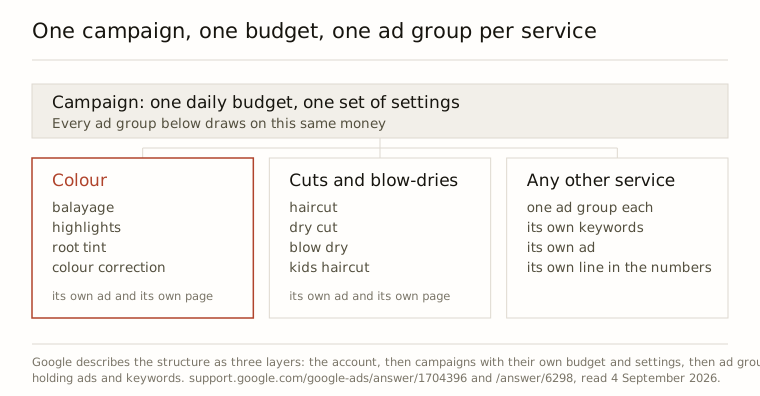
The catch is in the picture. The budget lives on the campaign, so splitting the words does not by itself split the money. What the split does buy you is control. Each service gets its own keywords, its own ad and its own page, and each one gets its own line in the numbers, so you can see what a colour enquiry costs you and take the money out of the groups that are only bringing fringe trims.
Match types decide who gets in
One word, three match types, three different amounts of traffic. The syntax is off the same Google page: broad match is just the word, balayage. Phrase match is the word in quote marks. Exact match is the word in square brackets. Phrase match shows on “searches that include the meaning of your keyword”. Exact match shows on searches that “have the same meaning or same intent as the keyword” and, in Google’s words, “gives you the most steering over who views your ad”.
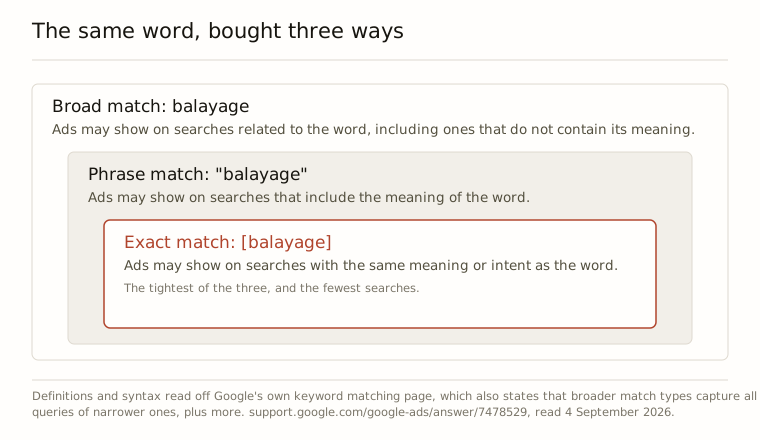
Google is straight about the trade. Broad match, it says, “helps you attract more visitors to your website”. More visitors is not the job. Eight colour appointments in a month is the job, and on £300 a month you cannot buy both. So the colour words you actually want go in as phrase and exact, and broad gets used carefully or not at all. One caveat from the same page, worth reading twice: Google calls it “critical to use Smart Bidding with broad match”, because a bid should move with each search. Broad match on a bid you set by hand is the thing Google itself tells you not to do.
The searches that look like colour and are not
Negative keywords “let you exclude search terms from your campaigns”, and colour needs more of them than cuts do. Balayage has a whole training industry around it: courses, models, kits, box dye, apprenticeships, people wanting it done free for practice. A fringe trim has none of that. We block 536 time-wasting searches before a client’s first click, and the list is the same shape every time: courses, jobs, apprenticeships, free models, cheap, DIY, wholesale.
Two things about negatives catch people out, both read off Google’s page today. First, negatives do not match close variants. Google’s example: exclude the negative broad keyword flowers and your ad will not show on red flowers, but it can still show on red flower. Block balayage model and balayage models can still get through. Second, negative match types do not behave like the positive ones. Negative broad blocks a search only if it contains all your terms, negative phrase needs them in the same order, and negative exact blocks only that exact search with nothing added to it.
What you can afford to pay for a colour click
Once colour sits in its own ad group you can price it on its own. A maximum cost per click is, in Google’s words, “a bid that you set to determine the highest amount that you’re willing to pay for a click on your ad”, and with manual bidding “you’ll set one maximum CPC bid for an entire ad group, but can also set different bids for individual keywords”. So the click from a woman typing balayage near me and the click from someone typing kids haircut do not have to cost you the same. They should not: one of those is half a day in your chair and the other is fifteen minutes.
Work out your own ceiling before you set one. Take the price of the colour service you want more of, take off the product and the chair time, and that is what one appointment really leaves you. Then decide how many of those clicks you are willing to pay for to get one booking. Nobody can hand you that number, because it is your price list and your town, and anyone who quotes you one without seeing either is guessing.
What a month of this actually looks like
Rachel Hartley at The Lockhouse spends £300 a month with us. In her words: “I’d tried boosting posts and it got me students. This got me eight colour clients in the first month and I didn’t touch a thing after signing up.” Eight colour clients out of £300 is £37.50 each, and our monthly fee sits on top of that. That is one salon and one month, and it is the only named result we have, so treat it as what happened to her rather than what will happen to you.
A month of numbers as the product reports them: £300 spent, 38 calls, 21 enquiries, £14 an enquiry. What we cannot tell you is which booking came from which search. Fresha and Treatwell do not hand over booking data, so nobody can honestly claim that. We count calls, form enquiries and booking click-outs, and we say so out loud.
If you would rather not do it yourself
That is what we sell: Google Ads for hair salons, barbershops and chair renters, built and run without you. One campaign split by service, so colour is not competing with cuts for the same money. £15 to £149 a month depending on your ad spend, no commission on bookings ever, 14 days free and cancel in one click. Your Google listing gets fixed before we take a card.
And if you could not take fifteen more colour clients next month, do not start. An ad that works on a full book is just an expensive way to run late.
Questions people ask
How do I see which searches my ad actually showed on?
In Google Ads, go to Campaigns, then Search terms under Insights and reports. It lists the terms that triggered your ads, and you can turn on columns showing which keyword matched and how closely. Google leaves out terms too few people searched for, so the list is real but never the whole of it.
Can I add too many negative keywords?
Yes, and Google says so on its own page: use too many and your ads might reach fewer customers. Add the ones you have actually seen in your search terms rather than a long list copied off a blog, then look again in a fortnight and see what got blocked.
Does any of this work for a barbershop?
The mechanic is the same: a separate ad group for the work you want more of, tighter match types on its words, negatives for the course and model searches. The sums are harder on a lower ticket, so put the longer, dearer services in their own group before you pay for fade clicks.
My prices are not on my website. Does that matter?
For the ad it can. Google says broad match takes the content of your landing page into account when it decides which searches to match you to. For the client it matters more: someone pricing up a full head of highlights is comparing before she rings, and a page with no prices sends her to one that has them.