
How to get clients when nobody walks past your salon
Most advice for a quiet salon says the same thing: take more walk-ins. If your salon is down a side street, upstairs, or round the back of a parade, that advice does not help, because nobody is walking past to walk in. The people you can reach are the ones already looking for a hairdresser on their phone. On that search a tucked-away salon loses much less than it does on foot, because Google counts distance from the person searching, not from the high street. So the job is to make your Google listing do what a shop window would: get you found, get her to the door, and only then think about paying for more.
Why the usual advice goes round in circles
A London salon owner put the problem plainly on r/smallbusinessuk: a new nail and beauty salon, a location getting “very little natural footfall”, and a question about how to get more people to notice somewhere a little hidden. Much of what ranks for that kind of question comes from booking software companies, and their headline tip is to accept walk-ins. That is fine for a salon on a busy street. For a salon nobody passes, it is the problem said back to you.
The new clients who matter to you never see your street before they choose you. She has just moved, or her hairdresser has retired, or she wants her colour done by someone who knows what they are doing. She types hairdresser near me, or balayage near me, into her phone on the sofa. Whether you are on the high street or two turnings off it barely comes into it.

On a map, a side street is not much further
Google publishes how it ranks local results. Its Business Profile help page says they are “mainly based on relevance, distance, and popularity”, and it defines distance as how far each business is “from the customer who’s searching”.
That last part is the point. On foot, the high street wins because that is where people are. On a phone she could be searching from anywhere: her kitchen, her desk, the station. Here are made-up round numbers to show the shape of it. Put your own streets in.
Say a woman searches from the station. She is 400 metres from the salon on the high street and 600 metres from yours. Another searches from home, on your side of town: 900 metres from the high-street salon, 700 metres from you. A third is at work across town: 1,500 metres from one and 1,600 metres from the other. Of those three, only the first ever walks past a salon door, and it is not yours. On the map you are the nearer salon for one of them and a short way behind for the other two.
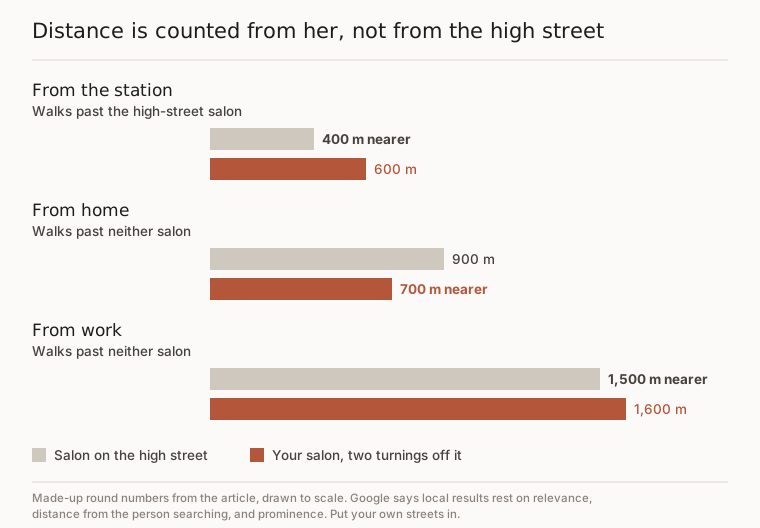
Distance is one of Google’s three things, and it is the only one you cannot change. The other two are yours to work on, and they cost nothing.
Fix the two things Google lets you control
Relevance is how well your profile matches what she typed. Google says businesses with “complete and accurate info are more likely to show up in local search results”. So: the right main category, every service you actually do listed, and opening hours that are true, including the days you are shut. If colour is what you want more of, make sure it is in your services, because that is a search you want to turn up for.
Prominence, which the same page also calls popularity, is how well known you are, and Google says it is based partly on how many reviews you have: “More reviews and positive ratings can help your business’s local ranking.” A tucked-away salon cannot borrow anything from its frontage, so reviews are doing the job a busy window would. Google’s reviews page suggests sending clients a Google link or a QR code.
Google’s rules on reviews are strict, so ask the right way:
- Ask everyone, not just the happy ones. Google does not allow businesses to “selectively solicit positive reviews”.
- Never give anything for it. A discount or a free fringe trim in return for a review is against the policy.
- Do not hand her your phone at the desk. The policy says businesses should not pressure people to write reviews while on the premises, or ask for specific things to be mentioned. Send the link that evening instead.

Get her from the map to your door
A hidden salon has a second problem that a high-street one never has. She found you, she booked, and on the day she walks up and down the main road looking for you. If she cannot find the door, her first appointment starts late and flustered, or she rings from the corner while you have foils in.
Three things on your Google listing help, and all of them are free:
- Put the full address in. Google’s address guidelines ask for building, suite and floor numbers and other unit details. If you are above a shop or at the back of a yard, that line matters. Google also says that if your business sits inside another one, like a shop in a shopping centre, you can ask for that to be shown on your profile.
- Put the pin on your door. The pin is where you appear on the map, so if it sits on the main road, that is where she will look. In your Business Profile, under Location, the Adjust option lets you move it onto your actual entrance. Google says changes usually show in about 10 minutes, though some take up to 30 days.
- Add photos of the outside, from every direction. Google’s photo tips say exterior photos help customers recognise your business “as they approach from different directions”, and suggest at least three, taken from each way people come and at different times of day. For you that means the turning off the main road, the door itself, and whatever she sees just before it.
If your booking system lets you add a note to the confirmation message, put one line of directions in it too. “Turn left at the chemist, we’re the green door” saves the call from the corner.
Borrow footfall from the businesses that have it
The café on the corner, the gym, the nursery, the florist: they get the passing trade you don’t. Ask if they will keep a few of your cards by the till, and keep a few of theirs on your desk. Offer their staff a reason to try you. It costs an afternoon of conversations, and it is the one part of the high street you can actually use.
The clients you already have know exactly where you are, too. A first-timer who comes with her friend never gets lost.
When the free fixes are done and the gaps are still there
If your listing is complete, the reviews are coming in and the midweek is still quiet, a small Google ad is the next step. A search ad shows at the top of the results to people looking for what you do, so which street you are on makes no difference to where it appears. Google Ads lets you show ads to people in, regularly in, or interested in the places you choose, so the money goes on the area your clients actually come from.
That is what Salon Ads Studio does: Google Ads for independent salons, ten minutes of your time to set up and then run for you, £15 to £149 a month depending on your ad spend, and no commission on bookings. We fix your Google listing for free before you pay anything, which covers most of what is above. We will also tell you if it is not worth it: if you cannot spend about £100 a month on ads, or there is not enough local demand, we say no.
If you want to see what your empty chairs cost you first, the calculator on our homepage works it out from your chairs and how your week usually goes. The button reads “What could I make?”
Questions people ask
Can I put an A-board on the main road pointing down to my salon?
Ask your council first, because the rules differ. Liverpool City Council charges £207 for a three-year licence and says the board must stand within the width of your own shop frontage, which rules out the corner of the main road. Hertfordshire needs no licence but wants 1.8 metres of pavement left clear. A roadside directional sign away from your premises normally needs advertisement consent from the planning authority.
Can I add something like behind the station to my salon's name on Google?
No. Google's guidelines say your name should be your real-world name, as it appears on your sign, and they list location details and being inside another business as things the name must not include. Adding them can get your profile suspended. Put the floor or unit number in the address instead, and let your outside photos show the way.
Street View shows the wrong building for my salon. Can I fix it?
Sometimes. Google says you can move your map pin so it lines up with a more accurate Street View image, or add your own 360 photos through Street View Studio. You can also report outdated imagery on Google's form, but Google says it cannot commit to a timeline for updating it, so do not wait on that.
Do I need permission for a sign on the front of my own salon?
Often not, but it depends on the sign. The Planning Portal says most illuminated signs, and signs set high up, above the bottom of the first-floor windows, normally need advertisement consent, while others are allowed depending on size, position and lighting. A listed building needs listed building consent even for a sign that would otherwise be fine. Ask your council's planning team before you pay a signwriter.
Is it worth moving to a busier street for the walk-ins?
Not as a first move. If a busier unit costs more, that is every month for years, and a lease is hard to undo. A complete Google listing costs nothing and a small ad can be stopped in any month. Do the free fixes, give them a couple of months, and see whether the gaps fill from searches. If they do, the street was never the real problem.
