
How to fill the quiet midweek days in your salon

You cannot turn a Tuesday into a Saturday. What you can usually do is stop paying twice for Saturday.
A midweek gap is rarely a shortage of clients. It is a shortage of clients who are free at eleven on a Tuesday, sitting in a diary that has already packed everyone it can into Thursday, Friday and Saturday. That distinction matters, because the two problems have different answers. If every day is down together, that is one question. If the same people are stacking into three days, that is a shape, and a shape you can do something about.
The gap has a shape
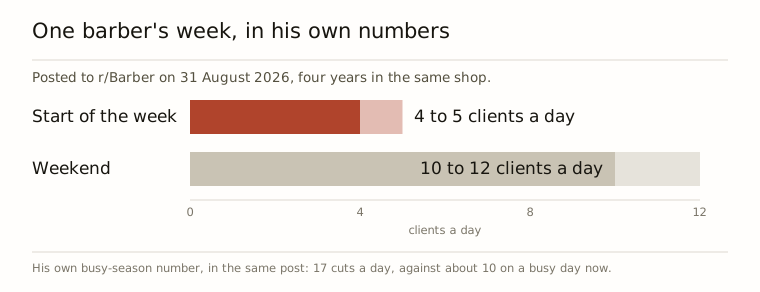
A barber posted this at the end of August, four years into the same shop:
4 -5 clients in the days of the start of the week and maybe 10/12 on the weekends.
He is not empty. In a good season he was doing 17 cuts a day, and lately it is maybe 10 on a busy day. But the thing he cannot fix by working harder is that his Monday and his Saturday are two different businesses.
Write your own two numbers down before you spend anything on advertising. Clients on your quietest day, clients on your busiest. If the quiet day is roughly half the busy one, the rest of this applies to you.

Why the discount is the expensive answer
Search this question and you get a list of midweek offers. Money off before two, a loyalty card, a Tuesday bundle. There is nothing wrong with any of it, but be clear about who sees it. A midweek offer goes out on your Instagram, your email list and your window, and every one of those reaches people who already come to you.
So the likely result is not a new client on a Tuesday. It is a regular who was coming on Saturday anyway, now coming on Tuesday for less money. The week looks flatter and the takings are down. That is worth doing on purpose when Saturday is turning people away. It is not a way to find anybody new.
What Google Ads can actually change about a Tuesday
This is where the ad schedule comes in, and where most advice stops one step too early.
By default a Google Ads campaign is set to show all day, which means the ads are eligible to appear right through every calendar day. You can change that. Google’s own page on ad scheduling says you can specify certain hours or days of the week when you want your ads to show, and set bid adjustments to raise or lower your bids for particular days and times.
Here is the part that catches people out. Narrowing the schedule does not lower the bill. The note on that same page says that when you use ad schedules, your campaigns pace toward a monthly spend of 30.4 times your average daily budget, regardless of how many days your campaign is active in a given month. Google’s spending limits page says it again in its own words: the monthly limit stays at 30.4 times the average daily budget, and the system paces to reach that full limit however many days the campaign is scheduled to be active.
Switching Saturday off does not save the Saturday money. It moves it onto the days you left switched on.
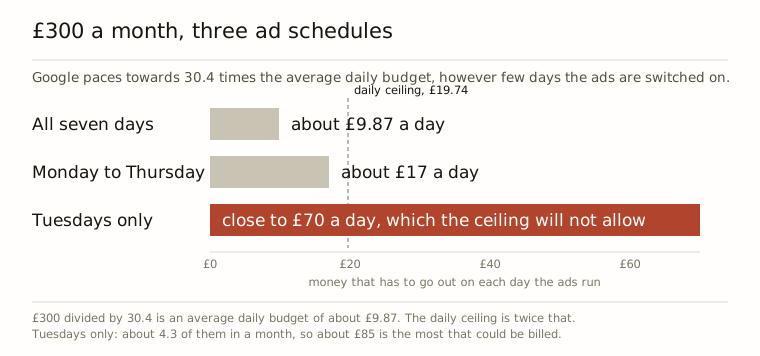
Take 300 pounds a month. Divided by 30.4, which is the average number of days in a month, that is an average daily budget of about 9.87 pounds. Run every day and that is roughly what a day gets. Run Monday to Thursday only, which is about 17.4 days in an average month, and the same 300 pounds has to go out across those days instead, at about 17 pounds a day. Same money, nearly twice as much of it landing in front of people while your midweek chairs are empty.
How narrow is too narrow
There is a floor under this, and it is arithmetic rather than opinion. Google will not bill you more than twice your average daily budget on any one day. On 300 pounds a month that ceiling is 19.74 pounds.
Now try Tuesdays only. About 4.3 Tuesdays fall in an average month, so putting 300 pounds through them means close to 70 pounds on each one. The ceiling says 19.74. So about 85 pounds is the most that could ever be billed, and the rest simply does not get spent, however hard Google paces at it.
One day a week is too narrow to be a schedule. Three or four days is a schedule. If Tuesday really is the only day you want, the honest thing is to expect a much smaller month than the number you typed in.

The part an ad cannot do
None of this makes anybody search on a Tuesday. Google’s ad scheduling page is blunt about it: if no one searches for your keywords at the time or day you scheduled, your ads are not going to show. There is no setting that creates demand at eleven on a Tuesday morning.
What there is, is whoever does search midweek. Someone typing balayage near me on a Wednesday evening is not thinking about your Saturday. She is thinking about the soonest appointment she can get. If your Saturday is full and your Wednesday is not, you are the salon that can see her this week, and that is worth more to her than money off.
Advertise the service, not the day
One more thing about midweek gaps. They are usually service shaped rather than day shaped. In most salons the hole is not spread evenly down the price list, and it tends to sit where the long appointments are, because a three hour colour is the hardest thing to fit into a working week.
If it is your colour column with the gaps in it, then come in on Tuesday is the wrong advert. A full head of highlights, this week, is the right one. That is why we build one campaign split by service rather than one advert for the salon: if the gaps are in colour, the colour searches get the money.
What we do about it
We build the campaign, set the schedule with you at the start, and run it. Ten minutes of your time at the beginning, then nothing. It is 15 to 149 pounds a month depending on your ad spend band, with no commission on bookings ever, 14 days free and one click to cancel. If you do leave, the free fixes we make to your Google listing stay yours, and so does everything they bring in. There is more on that in what happens to your bookings when you stop paying for ads.
Before you pay anything we fix your Google listing and block 536 time-wasting searches: courses, jobs, apprenticeships, free models, cheap, DIY, wholesale.
What we will not do is tell you which client came from which search. Fresha and Treatwell do not share booking data, and nobody who claims otherwise is being straight with you. We count calls, form enquiries and booking click-outs, and we say so.
One salon, one month, as the product reports it: 300 pounds spent, 38 calls, 21 enquiries, 14 pounds an enquiry. And Rachel Hartley at The Lockhouse, on 300 pounds a month: “I’d tried boosting posts and it got me students. This got me eight colour clients in the first month and I didn’t touch a thing after signing up.”
That is one named salon, and it is thin proof, and we would rather say so than dress it up. The free assessment takes forty seconds and gives you your local search numbers and the faults on your Google listing before there is an account or a card involved. Start there, look at your own two numbers, and decide afterwards.
Questions people ask
Can I bid more on the quiet days instead of switching the busy ones off?
Yes. Google's ad scheduling page lists bid adjustments alongside the days and hours setting, so you can raise or lower what you bid for particular days and times without turning anything off. On a small budget that is often the gentler version: a nudge up on your quiet mornings, a nudge down on Saturday.
Do my ads follow my salon's opening hours on their own?
They can. Google's page on setting an ad schedule for a Smart campaign says that if you use a Business Profile and have store hours set in your account, the campaign's ad schedule syncs to those hours automatically. Worth knowing the other way round too: wrong hours on your listing become wrong hours on your ads.
What happens if I change the budget halfway through the month?
Google's spending limits page says the rest of the month paces to your new average daily budget multiplied by the remaining calendar days in the month, not the remaining days your ads are scheduled to run. Your spend on an active day still will not go past twice the new average daily budget.
Can I be charged more than the monthly figure I set?
No. Google separates what your clicks cost from what you are billed. On rare days of very high demand the served cost can run past a limit, but the billed cost does not: Google covers the difference. Your bill stops at 30.4 times your average daily budget.