
How to fill a new stylist's column

If she is on a wage, it is your job. Every empty hour in a new stylist’s column is an hour you are already paying for, so the cost lands on you whether you plan for it or not. There are two jobs here, and they get blurred. Moving clients your other stylists cannot fit in costs nothing and is a rota decision. Finding people who have never heard of you costs money, and those people search for a service, not a stylist’s name, so the service is what you advertise.
It is a common shape. A stylist comes from a busy salon where reception filled her book, she joins a smaller one, and her column sits empty while everyone waits for someone else to fix it. Here is how to put a number on it, and what to do first.
Count her empty hours first
Open the booking system and count the hours she was in the building with nobody in her chair last week. Not the ten minutes between clients. The hours.
Write them down by day, because the pattern matters as much as the total. Here is a made-up example so you can see the shape. She works 30 hours over five days, six hours a day, Tuesday to Saturday:
- Tuesday: 0 hours booked, 6 empty
- Wednesday: 1 booked, 5 empty
- Thursday: 1 booked, 5 empty
- Friday: 3 booked, 3 empty
- Saturday: 5 booked, 1 empty
That is 10 hours booked and 20 empty, and 16 of the 20 empty hours fall Tuesday to Thursday.
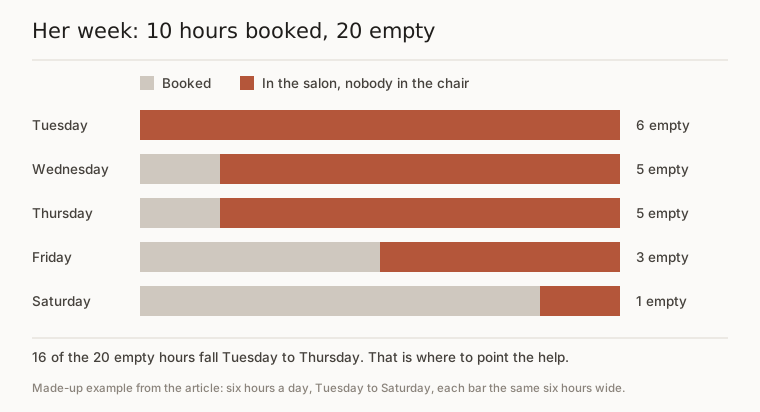
Saturday nearly fills itself. The problem is the middle of the week, and that is where both the free fix and any ad have to point.
What the empty column costs you
Now put her wage against it. From April 2026 the National Living Wage for anyone 21 and over is £12.71 an hour, according to GOV.UK’s minimum wage rates page. Say that is what you pay her, to keep the sums simple. If you pay more, use your own figure.
- 30 hours at £12.71 is £381.30 a week.
- 10 of those hours are booked, which is £127.10.
- 20 are empty, so £254.20 a week pays for time with nobody in the chair.
- Over four weeks, that is £1,016.80.
That is before anything you pay on top, such as employer’s National Insurance or pension.
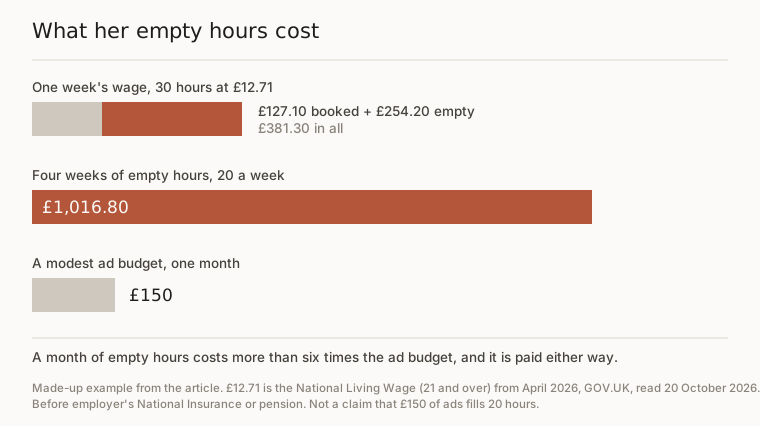
Set that next to a modest ad budget of £150 a month and the empty hours cost more than six times as much. That is not a promise that £150 of ads fills twenty hours. It is the size of what you are already spending on an empty column, a number most owners never write down. The money goes out either way. The only question is whether any of it is bringing people in. If you want to know what a new client is worth paying for, we worked that out in what a new client should actually cost you.
Whose job it is
Her old salon booked her clients for her because it had the reception, the walk-ins and probably the marketing to do it. That was the salon’s work, not hers, and she was not wrong to expect something like it.
On a wage, the empty hours are your cost, so finding new clients is your job. She can help, and there is a section on her part below. But she cannot buy advertising for your salon, and she should not be expected to fund it out of her pay. Moving her onto commission changes who feels the empty hours. It does not make them go away.
One thing will quietly sink her. If the walk-ins and the “is anyone free?” phone calls go to whoever is senior, she never sees the clients who could build her book. Decide who gets them before the phone rings.

The free job: give her your overflow
Look at your own column and everyone else’s. Anyone booked more than a week or so ahead is turning people away or making them wait, and some of those people would happily see someone else sooner.
- On the phone: when the stylist asked for is booked up, offer the new stylist’s first free slot before a date three weeks away. Say what she is good at, not just that she is free.
- Walk-ins and “whoever is free” bookings: these go to her by default while her column is empty.
- Online booking: check she shows up as bookable for the services she actually does, at the hours she actually works. A stylist who cannot be booked online does not exist to someone booking at 9pm.
- Your own regulars: if you are booked solid, ask the ones who only come for a trim or a blow-dry whether she could look after them.
None of this costs a penny, and it puts real clients in her chair from the first week. It does not bring anyone new into the salon, though. It moves clients you already had. If the whole salon has gaps, overflow will not fill her column, and that is the second job.
The paid job: new clients search for a service, not a name
Nobody new searches for a stylist they have never heard of. They search for the thing they want and the place they want it: balayage near them, a hairdresser in their town, a cut on a Wednesday evening. That is good news for a new stylist, because a search ad never needed her to have a following.
So point it at her. If the example above is her week, the ad wants to sell the services she does best, on the days she is free, which means Tuesday to Thursday. If she is strong at colour, sell colour. If her prices sit below your senior stylists’, say so, because that is a real reason to book her. And send the click somewhere the person can see her free slots, not a page where every stylist looks booked until next month.
Be clear about what you can count. You can count calls, enquiry forms and clicks through to your booking page. You cannot know for certain which client came from which search, and anyone who says they can is guessing. We wrote about that in how you know a booking came from the ad. For a new stylist the simplest measure is the one you already took: her empty hours, counted the same way, every week.
If the whole midweek is quiet and not just her column, filling the quiet midweek days covers the salon-wide version.

What she can do herself
Her part costs her time, not money, and it is the part that keeps clients once they arrive.
- Rebook before they leave the chair. A first visit that leaves without a next date is a client who might come back. One with a date in the diary is a client.
- Ask happy clients for a Google review that mentions her by name. It builds her a record on your listing that the next person can read.
- Photograph her work, with the client’s permission, so your listing and your posts have something to show that is hers.
What none of this does is find people who have never heard of the salon. That is still the paid job, and it is still yours.
Where to start
Count her empty hours this week, by day, and multiply by what you pay her. That is what the empty column is costing you now. If you want to know what those empty hours add up to over a year, the free assessment works it out from your week in a few taps, and shows roughly how many new clients a monthly budget could bring in. No account, no card.
Questions people ask
If I move her onto commission, do I still have to pay minimum wage?
Yes, if she is employed. GOV.UK says the minimum wage applies to all eligible workers even if they are not paid by the hour, so her commission has to work out at least at the minimum hourly rate. Working time includes time at work and required to be working, so an empty hour she has to spend in the salon still counts.
Should a new stylist have her own Google Business Profile?
Usually not yet. Google's guidelines allow an individual practitioner a profile of their own, and describe one as a public-facing professional, typically with their own customer base. A new stylist with an empty column does not have that base yet, and a second profile at your address splits reviews between two listings. Keep her on the salon's profile, with her work in its photos.
Should she charge less than my senior stylists while she builds up?
If she is newer to the trade, a lower price gives a client a plain reason to choose her. Set it as her normal price, not a discount, so nobody expects it to jump overnight. If she is as experienced as your senior stylists, charge the same and sell what she is good at instead.
What if she leaves and takes the clients the salon found for her?
It can happen, and you cannot stop a client following a stylist she likes. What you can do is keep every booking in the salon's own system and on the salon's phone, not her personal mobile or messages, so each client's history and next appointment sit with the salon and another stylist can pick them up.
