
How to compete with the cheap barber down the road
You do not beat a cheaper barber by becoming a slightly cheaper barber. Work out what matching him actually costs on the heads already in your chair before you touch a price, because that bill arrives first and it arrives every week. Then decide which of the two barbershop customers you are set up for, and stop paying Google to put your ad in front of the one who was always going to walk past you for three pounds. That last part is a setting in your account rather than a state of mind, and it is the bit you can change this afternoon.
Work out what matching him costs before you touch a price
Say you do 60 cuts in an average week at £18. That is £1,080.
A shop opens down the road at £15 and you decide to match it.
The £3 does not come off the new trade you are hoping to win. It comes off the 60 people who were already coming to you. That is £180 a week, and £9,360 over a year, gone before one new customer has sat down. The same 60 people, bringing in £900 a week instead of £1,080.
Then there is the standing still number. At £15 you need 72 cuts a week to take the same £1,080. That is 12 more heads, every week. At half an hour a cut it is six more hours on your feet for exactly the same money at the end of it.
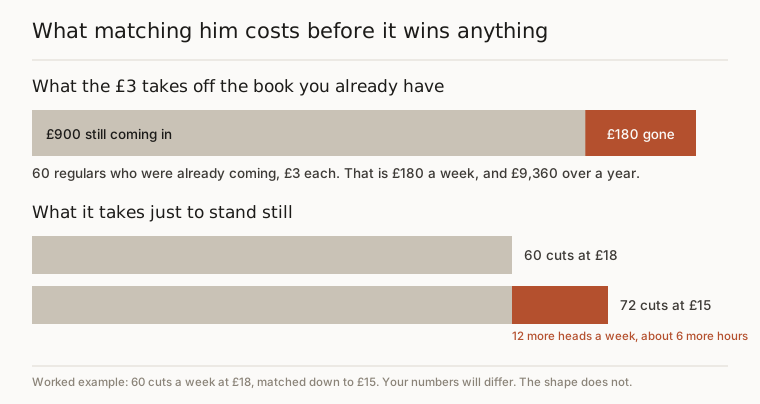
Your numbers will not be these ones. Put your own in: your price, your cuts in an average week, his price. The shape does not change. A price cut is paid for first by the people who were already loyal to you, and the extra work turns up afterwards.
Most of the advice written about this ends at do not panic and do not discount. That is right, and it is not a plan. The rest of this is the plan.
Two customers, not one market making one choice
The man who wants a ten minute cut for as little as he can pay and the man who wants the barber who knows how his crown sits are not the same person having a wobble about money. They want different things, and they wanted different things before the new shop opened.
A cheap shop pulls the first group hard. That group was shopping on price before it opened, and will shop on price again the day somebody undercuts it. It pulls far less of the second group, because they book by name.
So the useful question is not how do I win those people back. It is which of the two am I set up to serve, and does my advertising say so out loud. If you are the shop people book with by name, an ad that says barbers near me is out competing for the wrong man. An ad that says skin fade, beard trim, the same barber every time, kids on a Saturday morning, is talking to somebody who was never weighing you up over £3.
Some will go. A few come back the first Saturday the queue at the cheap shop is out of the door, and some never do. You cannot keep everybody, and trying to is exactly how a price cut happens.
Stop paying to be shown to the price shoppers
If you are running Google Ads, the price shoppers are not just walking past your window. You are paying for some of them to click.
Google’s search terms report lists what people actually typed before your ad appeared. Google’s own description of it is that the report shows actual terms that a significant number of people searched for which triggered your ad. Open it and the cheap ones are usually sitting right there: cheap barber, cheapest haircut near me, £10 haircut. Every one of those is money off your card for somebody who was comparing prices rather than shops.
Negative keywords are how you stop paying for them. Google’s own line is that negative keywords let you exclude search terms from your campaigns and help you focus on only the keywords that matter to your customers.
Two things about them that the usual advice leaves out.
The first is that they leak. Google says negative keywords do not match close variants, and gives its own example: block flowers and your ad can still show on red flower. Which means blocking cheap haircut does nothing at all about cheap haircuts. You have to add the plurals and the synonyms yourself. Capitals and misspellings are handled for you.
The second is that you can go too far. Google’s own warning is that if you use too many negative keywords, your ads might reach fewer customers. Block the word deal and you have also blocked the man looking for a good deal on a beard trim who would have paid your price happily.
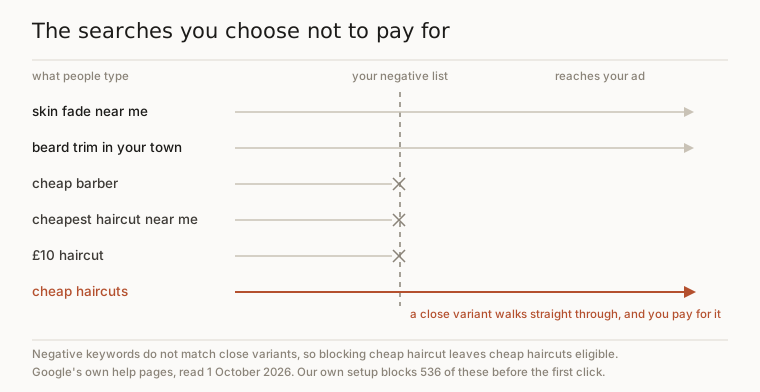
That weeding is most of what we do on an account before anything else. The setup blocks 536 time-wasting searches before the first click: courses, jobs, apprenticeships, free models, cheap, DIY, wholesale. Then the search terms report gets read every week, because the list is never finished.
Every Google setting described above was read off Google’s own help pages on 1 October 2026.
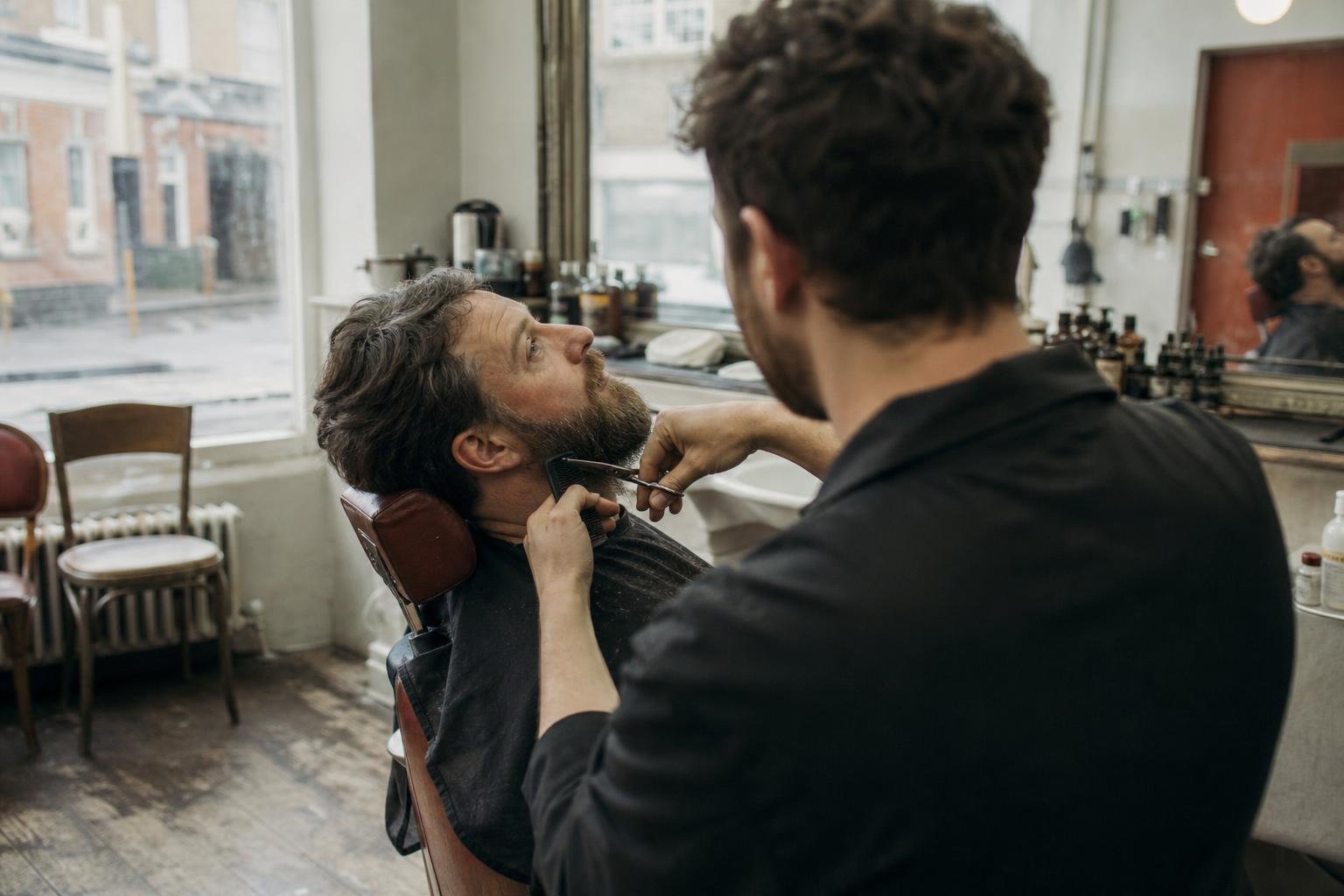
Advertise the work he is probably not doing
A cheap shop is built on speed. Volume through the chair is the whole model, which means the long jobs are the ones it wants least and often does worst.
So stop buying the generic search. One campaign, split by service, with the money behind the work you actually want more of: the skin fade, the beard shape, the restyle, the kids’ slot on a Saturday morning, the Thursday afternoon nobody books. Somebody typing beard trim and the name of your town has told you what they want before they click anything. Somebody typing barber near me has told you nothing.
Then fix the listing. Your Google listing is what most people see when they look you up, and it decides whether you look like somewhere worth the extra few pounds. We put that right before anybody pays us anything, and there is a longer piece on why your salon does not show up on Google Maps if yours has gone missing altogether.
For what the money does instead of coming off your prices: at one hair salon on £300 a month, a month of ads produced 38 calls and 21 enquiries. That is one salon and one month. It is not a barbershop, it is not a promise, and it is the only honest version of this we have.
Before you decide it is him at all
Two sanity checks, both free.
A cheap opening price is often an opening price. You do not know his rent, his staff costs or how long he can hold it, and rebuilding your business around somebody else’s launch offer is a bad trade. Nobody writing about price wars can tell you how long his will last, and that includes us.
And make sure it is actually him. A quiet month has more than one cause, and the three we see most often are the whole market going quiet, an ad account that stopped working without anyone noticing, and a listing people cannot find. Those are three different problems with three different fixes: why your bookings dropped this month, your ads used to work and now they don’t, and when a new salon opens on your street.
What to do this week
Three things, in order, and none of them is a price change.
- Do the arithmetic at the top with your own numbers. If matching him means 12 more heads a week, you already have your answer.
- Open your search terms report and block the price searches you are paying for.
- Pick the two or three services you want more of and put the ad money behind those rather than behind barbers near me.
If you have not got a website to send the clicks to, that is less of a blocker than it sounds: Google Ads for a barbershop with no website covers it.
We build and run this for independent barbershops and salons for £15 to £149 a month depending on what you spend on ads, with no commission on bookings ever, and we fix your Google listing before you pay for anything. Ten minutes at the start, then nothing.
Questions people ask
What if I have already cut my prices?
Putting a price back up is harder than never dropping it, so do not rush it. Hold the new price for the regulars you kept and set the old one for new bookings, or give the difference back as a longer appointment instead. Moving the number quietly twice in a quarter is what annoys people, not the number itself.
Is it worth matching his price just on the quiet days?
That is a different thing from a price cut and it is usually safer, because a cheaper Tuesday costs you nothing on a Tuesday you were empty anyway. Keep it shaped as a day rather than as your price, and advertise the day instead of the discount.
Should I put my prices in the ad?
It is worth trying if you are the dearer shop. Somebody who reads the number and still clicks has already decided your price is fine, and somebody hunting for a tenner tends not to click at all. Fewer people come through, and the ones who do already know what it costs.
Can I block too much and end up invisible?
Yes. Google warns that if you use too many negative keywords your ads might reach fewer customers, so block the price words rather than whole subjects. Read on Google's own help pages on 1 October 2026.
Does any of this work if he is simply better than me?
Then none of it helps, and we would rather say so. Advertising brings people to the door. What happens in the chair is yours, and a campaign pointed at a shop that is not ready just spends money faster.
