
How to attract high-end clients to your salon
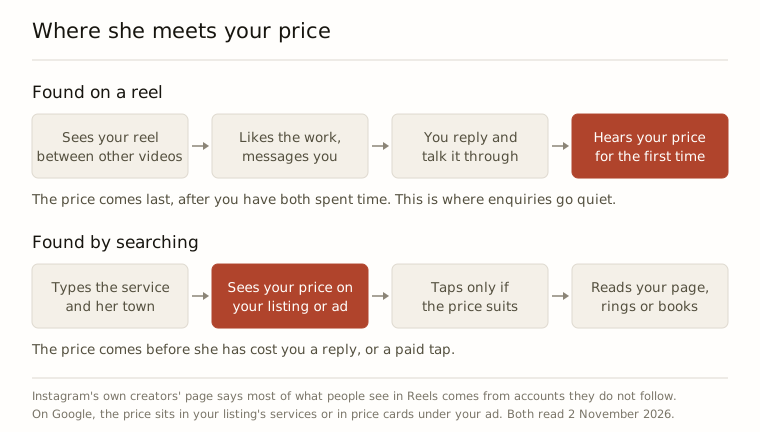
High-end clients mostly come from places where they meet your price before they meet you. A woman who has typed balayage specialist and her town into Google, looked at three salons and opened your page knows roughly what she is in for. A woman who saw your reel between a dog video and a recipe does not, and the first time she hears the number is in your messages. That is usually where the enquiry goes quiet. So the work is less about looking expensive and more about being found where price-tolerant clients already look: search, your Google listing, and the clients who already pay you.
Two stylists asked this in October
On Reddit’s r/hairstylist at the start of October, a cut specialist in an expensive area said her regulars stay but she cannot find enough new ones, and that “the inquiries I get usually go silent when they hear the price”.
At the end of the month a newly qualified stylist in the US came at it from the other side. Her first salon had her doing cheap blow-dries and finding her own clients by posting videos. It worked, in a way: plenty of clients came. They were cheap clients, and she has since moved salons and wants a different clientele.
Different ends of the same problem. Where she found clients decided what those clients expected to pay.
Why the enquiry goes quiet
Instagram is open about what Reels is for. Its own creators’ page on reach, read today, says Reels is “designed to help you discover new things, with an emphasis on entertainment”, and that most of what people see there comes from accounts they do not follow. That is brilliant for being seen by strangers. It also means the stranger was not looking for a hairdresser when she found you. She liked the work, she sent a message, and your price is the first number she has seen. Some of those women will pay it. Plenty were never shopping at that level, and nothing in a reel told them so before they asked.
Search runs the other way round. Nobody types colour correction and their town into Google by accident. She is already looking for that service, she can open three salons side by side, and if your listing or your ad carries a price, she has seen it before she ever contacts you. By the time she rings or books, the price is not news.
None of this makes a reel the wrong place to show your work. It makes it the wrong place to expect a stranger to arrive ready for your price.
Put your premium services on your Google listing
Your Google Business Profile has a services list, and it is free. Google’s help page on managing services, read today, says that when local customers search for something you offer, that service may be highlighted on your profile, and that on the Google Maps app people can see your full menu under Services. You can add a description and a price to each one. Custom service names that include prices are rejected automatically, so the price goes in the price field, not the name.
So add the services you want more of, one at a time, by the names people use for them: colour correction, lived-in blonde, restyle, whatever you actually sell. Give each a sentence on who it suits and how long it takes. A woman reading that on Maps is choosing with the number already in front of her.
If you have a website, each premium service deserves a page of its own too. We went through what goes on one in our piece on colour clients, and the idea is the same at any price.
A small ad on the exact service, with the price on it
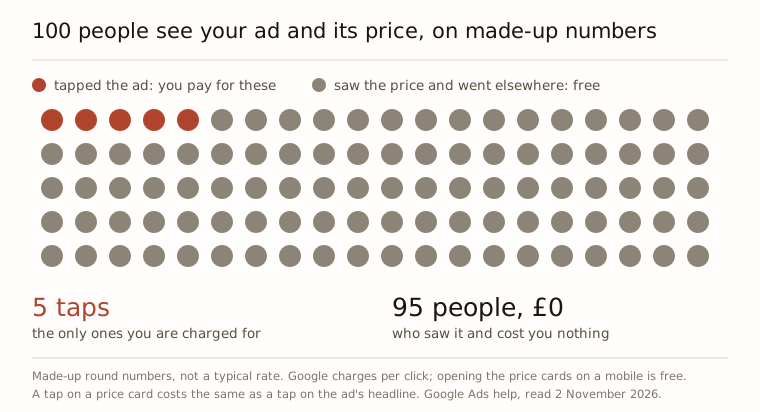
If you advertise, premium work suits Google Ads better than most, for one reason: you are not paying for people to see you. Google’s definition of its standard pricing, read today, is that you pay for each click on your ad. Someone who sees the ad, sees the number and scrolls on has cost you nothing.
And Google lets you put prices on the ad itself. Its help page on price assets, read today, uses a hair salon as its example, and says the prices show as a set of up to eight cards under the ad, on desktop and mobile. You need at least three items. On billing, the same page says a tap on a price card costs the same as a tap on the ad’s headline, and tapping to open the cards on a mobile is not charged.
Here is what that means, with made-up round numbers. Say 100 people see your colour correction ad with its from price in a card underneath, and 5 of them tap. You pay for those 5 taps. The other 95 saw your price and went elsewhere, and that cost you nothing at all. Set that against an Instagram enquiry, where the woman who balks at the price has already had a reply from you.
Build the ad on the words she types: the service name with your town, the service name with near me, the service name with specialist. Then keep the bargain hunters out by adding words like cheap, deal, offer and student as negative keywords, so the ad never shows when they are in the search. Read the searches that actually triggered your ad for the first fortnight and add anything else that does not belong. If a small budget worries you, our piece on £100 a month works through what it buys.
The clients who already pay your price
The women already in your chair at your prices are the one group who know exactly what you charge and think it is worth it. When one of them sends a friend, the friend can ask her what it cost before she ever contacts you. That is the search route again, just over a coffee instead of on a phone.
So make it easy. Tell the regulars you get on with that you have room for new clients, and which days. If you thank people for sending someone, make the thank-you something to do with their hair rather than money off, so nobody in the chain learns a lower price than the one you charge.
Keep Instagram, but as your portfolio
None of this means you stop posting. A woman who found you on Google may well look you up on Instagram before she books, and that is where your work convinces her. The difference is that she arrives already knowing the price. Keep posting for her and for the people who already follow you, not in the hope that the next stranger to see a reel will be ready to pay. We set the two side by side in Google Ads or boosting Instagram posts?.
If you would rather not run the ads yourself
That is what we sell: Google Ads for hair salons, barbershops and chair renters, built and run without you. One campaign split by service, so a premium service gets its own ad group and its own words, and 536 time-wasting searches blocked before your first click, cheap and free models among them. £15 to £149 a month depending on your ad spend band, no commission on bookings ever, and your Google listing gets fixed before you pay anything. There is no free trial: your first payment is our fee plus your first month’s ad budget, and that switches the ads on. The empty chairs calculator on our homepage, the button that says What could I make?, shows what your empty chairs cost you in a year before you sign up to anything.
Two honest limits. Under about £100 a month of ad spend, we will tell you not to bother. And if your book is already full for the next month, do not start: an ad that fills a diary you cannot fit is money spent turning women away.
Questions people ask
Can I target my Google Ads at people on higher incomes?
Not in the UK. Google's demographic targeting page, read today, lists household income targeting for search ads in a set of countries including the United States, Australia and Canada, and the United Kingdom is not one of them. Age and gender are available. For a premium service the search does the filtering for you: a woman typing colour correction and her town has chosen the service before she sees your name.
What if I only have one premium service to put in price cards?
Google's price assets page, read today, says you must enter at least three items and recommends five or more, with up to 25 characters for each header and each description. So list the parts of the service a client actually chooses between, such as a consultation, a first appointment and a maintenance visit, each with its own price and a link to the right page.
Should I offer new clients a discount to try me?
Think hard before you do. A first-visit discount is the first price she learns from you, which makes your real price the surprise, just one appointment later. If you want to give a new client a reason to book, a free consultation or a gloss added to the first appointment keeps the price she pays the same as everyone else's.
Is it worth paying an influencer to post about my salon?
It puts you back in someone's reel, so the price still arrives last. If you go ahead, the Advertising Standards Authority's influencers' guide, a fourth edition dated 23 October 2026 and written with the Competition and Markets Authority, covers when a post has to be labelled as an ad and what counts as a payment or incentive. Read it before you agree anything, free hair included.
