
How many clients does a hairdresser need to fill a chair?

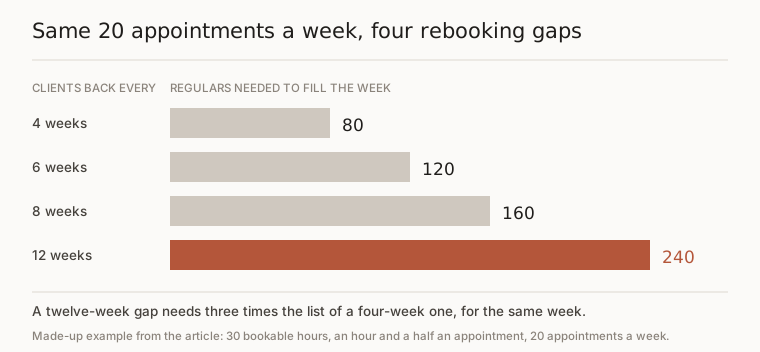
The number of clients it takes to fill a chair is your appointments a week multiplied by the number of weeks your clients leave between visits. Four appointments a day, five days a week, everyone back every eight weeks: that is 160 regulars. Get them coming every six weeks and 120 will do it. Every twelve weeks and you need 240.
So there is no one right number, and any figure you see quoted online is somebody else’s column, on somebody else’s prices and rebooking gap. Yours takes about ten minutes to work out. The part that matters more comes after it: how many new faces a month it takes to stay full.
Start with the appointments, not the clients
Count the hours you are actually bookable in a normal week. Not the hours on the door, the hours you would take a client.
Then divide by the length of your average appointment, including the time it takes to sweep up and get the next person in the chair. Here is the example the rest of this piece uses. It is made up, so swap in your own as you go:
- Five days, six bookable hours a day: 30 hours.
- An average appointment, colours and cuts together, takes an hour and a half.
- 30 hours divided by an hour and a half is 20 appointments a week. Four a day.
That 20 is what full means for her. It is a ceiling, not a target, and it is the only number in the sum that does not depend on anybody else.
Then multiply by how often they come back
A client who comes every eight weeks takes up one eighth of a slot each week. So to fill one slot every week you need eight of her, and to fill twenty you need 160.
That is why two stylists working the same hours can need completely different client lists. Short cuts on a four-week gap fill those 20 slots with 80 people. A colourist whose clients come in for a full head every twelve weeks needs 240, three times as many, for exactly the same week.
Real columns are mixed, so count yours in groups. Do not average the gaps: the average of four weeks and twelve weeks is eight, and that gives the wrong answer. Here is the example stylist’s column when it is full:
- 60 clients who come every 6 weeks: 10 visits a week.
- 40 clients who come every 8 weeks: 5 visits a week.
- 60 clients who come every 12 weeks: 5 visits a week.
That is 160 clients and 20 visits a week. Full. Your diary already holds the numbers for your own version: go back through the last few months and sort your regulars by how often they come.

What an empty slot costs
Now the money. Say her average appointment is £50, and most weeks 4 of her 20 slots are empty. That is £200 a week of work she was in the building to do. Over a 48-week working year it comes to £9,600.
If you rent a chair, the empty slots land in a different order, because the rent comes first. Say the chair is £150 a week. At £50 an appointment, the first three appointments of every week go to the rent, and nothing is yours until the fourth. A quiet week and a full one cost exactly the same to sit in. Running Google Ads when you rent a chair does the same sum against an ad budget.
How many new clients a month it takes to stay full
This is the part almost nobody works out, and it is the one that tells you whether you need to advertise at all.
Regulars drift. They move house, have a baby, change jobs, try someone nearer. Even a full column loses a few a month. And not every new face turns into a regular: some come once for a wedding, some were never going to come back.
So two more numbers from your own book decide it:
- How many regulars you lose in a typical month. Count the ones who were due and never rebooked.
- Of the new people who sat in your chair three months ago, how many have been back since. What a new client should actually cost you walks through counting that properly.
In the example, she loses two regulars a month, and one in three first-timers comes back. So just to stand still she needs six new faces a month. Six come in, two stay, and those two replace the two who left.
Filling her four empty slots is on top of that. On an eight-week gap, four more visits a week takes 32 more regulars. At one in three, that is 96 first visits, or eight a month across a year. So she needs fourteen new faces a month, every month for a year, to go from four slots short to full.
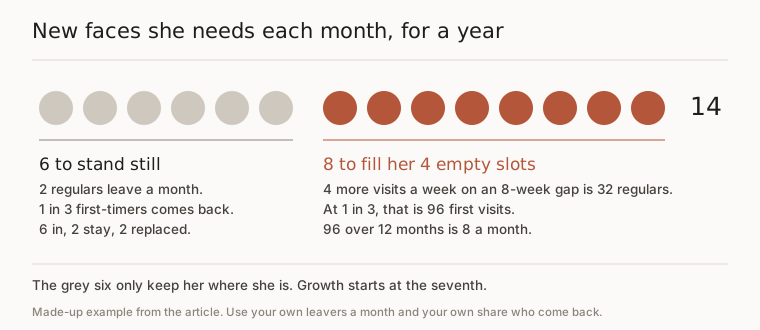
That is the number to take to anyone selling you clients, whether it is an ad, a marketplace or a voucher site. Not more clients. Fourteen a month, and how many of them they expect to come back.
When the sum says you do not need more
Sometimes it comes out the other way. If you lose very few regulars a month and your empty slots fill most weeks anyway, you are full and you know it. Then the useful moves are inside the book: shorter rebooking gaps, booking the next visit before she leaves the chair, a price rise. Paying to find new clients you cannot fit in is money spent on people you will have to turn away.
The same goes if a full chair would carry your turnover past the VAT threshold and you would rather not cross it. That is a real decision, and the sum for that one is worth doing before any advertising.

Do the sum on your own book
Five lines on the back of an appointment card:
- Bookable hours a week divided by your average appointment length. That is your slots a week.
- Each group of regulars divided by its rebooking gap in weeks. Add them up and set the total against your slots.
- Empty slots a week times your average appointment price. That is what the gap costs you.
- Regulars you lose in a month, and the share of first-timers who come back.
- The first divided by the second. Two lost a month at one in three is six new faces, just to stand still.
If you would rather not do it by hand, the empty chairs calculator on our homepage (the button that reads “What could I make?”) asks your business type, your chairs and how your week usually goes. It shows what the empty ones cost you in a year and what an ad budget could win back, before there is an account or a card involved.
Questions people ask
How do I count a client who only comes once a year, for a wedding or a big colour change?
Put her in a group of her own with a 52-week gap. Each one fills a fifty-second of a slot a week, so it takes 52 of them to fill a single weekly slot. Worth having, but they will not hold a column up, and they are the first ones to leave out when you work out who you lose each month.
What if I only work three days a week?
The sum shrinks with you. Three days of six bookable hours is 18 hours, and at an hour and a half an appointment that is 12 slots a week. On an eight-week gap, 96 regulars fill it. The new faces you need each month shrink less neatly, because clients drift away at their own pace however many days you work.
How long does it take to build a full column from nothing?
In the example, a full column is 160 regulars. If one in three first-timers stays, that is 480 first visits, before allowing for the ones who drift away along the way. At 20 new faces a month that is two years. At 40 a month it is one. Put your own numbers in, and be suspicious of anyone who promises faster.
Do clients who first booked through Treatwell or Fresha count as my regulars?
Yes. For this sum a regular is anyone who keeps coming back, whoever made the first introduction. Where she found you matters to a different sum, which is what she cost to find. Count her in the group that matches how often she comes, the same as anyone who walked in off the street.
