
Google Ads or boosting Instagram posts for a salon?

If you can only fund one of them this month, put the money on search.
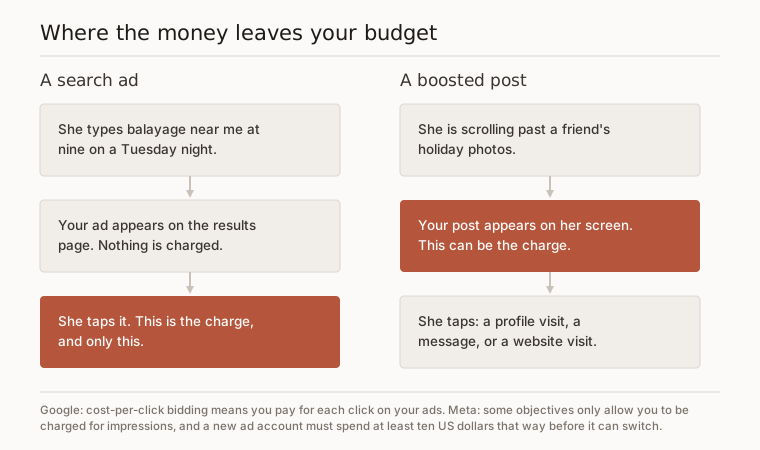
Someone who types “balayage near me” at nine on a Tuesday night has already decided to spend money on her hair. The only thing left to settle is who gets it. A boosted post arrives while she is looking at a friend’s holiday photos, so it has to create the want before it can collect the booking. Same pound, two very different moments.
That is the short answer. The longer one matters, because Instagram still has a job in a salon, and it is not the job the boost button is selling you.
What the boost button actually sells
Meta sets out boosting plainly on its own help pages. You take a post you have already put up, turn it into an ad, then set a goal, an audience, a daily budget and how long it runs. The goal list is three items long: more profile visits, more website visits, or more messages.
Read that list again, because it is the whole argument. None of the three is an appointment. Two of them are someone looking at you, and the third is someone typing to you, which still needs answering while you have colour on your gloves.
A search ad is not magic either. It also ends at a click or a phone call. The difference is not the finish line, it is where the person was standing when the gun went off.
Where the money leaves your account
On Google the mechanism is cost per click. Google’s own glossary puts it in one sentence: cost-per-click bidding means that you pay for each click on your ads. You set the highest you are willing to pay for one click, and Google says that is the most you will typically be charged, and that you will often be charged less, sometimes much less. If nobody clicks, nothing leaves the account.
On Meta it depends what was picked. Meta’s own page about getting charged says your charge choice tells them what event you want to cause money to be removed from your budget, and that some marketing objectives only allow you to be charged for impressions, which is their word for your ad appearing on somebody’s screen. The same page says that a new ad account has to spend at least ten US dollars being charged for impressions before it can be charged for anything else.
So the first tenner of the first boost you ever run buys appearances, by design and in the open. That is not a scandal and nobody is hiding it. It is just worth knowing on a Sunday night with your card in your hand.
What £250 buys in a month
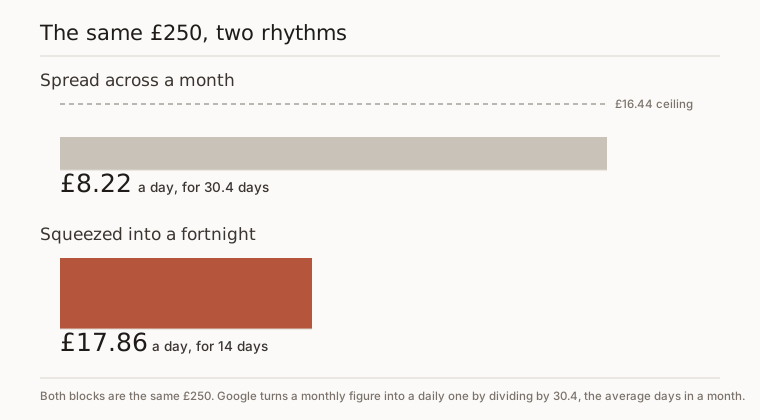
Google turns a monthly figure into a daily one by dividing by 30.4, the average number of days in a month. Its own worked example is 304 dollars a month becoming 10 dollars a day. Put £250 through the same sum and you get £8.22 a day.
Google then caps the damage in both directions. You will never pay more than twice your average daily budget on any single day, which on £250 a month is £16.44, and never more than 30.4 times it in a month, which is the £250 you set in the first place.
A boost works the other way round. You set the daily amount and the number of days it runs, so the same £250 across a fortnight is about £17.86 a day: a heavier, shorter push. Neither sum tells you what a client costs you. That comes out of your prices and your postcode, and it has a piece of its own.

The client who does both
Most of the time she is not choosing a channel at all. She sees your balayage on a Wednesday, thinks nothing of it, and three weeks later types your salon’s name, or “hair colourist” and her town, into Google. If she books, which one earned it?
We cannot tell you, and nobody else can with a straight face either. Fresha and Treatwell do not hand over booking data, and a client is not a tracked parcel. What we do is count the things that can actually be seen: calls, enquiry forms and taps on the booking link. Likes are not on that list.
When a boost is the better bet
There are cases where the boost is the right call, and pretending otherwise would be sales talk.
- Anything with a date on it. A launch night, a charity cut day, a late opening. Nobody searches for an event they have never heard of.
- Anything nobody thinks to type. If people do not search the words, a search ad has nothing to sit next to, and a picture of the work is the only way to explain it.
Neither of those is your quiet Tuesday. Filling that is a searching problem, not a scrolling one.

What we would do with £250
- Fix the free things first. Your Google listing costs nothing and it is usually where the bookings leak away. We do that before anyone pays us, and it is a whole job on its own.
- Put the ad money behind the service you want more of rather than behind the salon in general. A colour search and a cut search are different searches and worth different money.
- Keep posting on Instagram. It costs nothing but your time, and it is what she checks after she has found you and before she rings.
- At the end of the month, read the search terms report. Google’s own definition of it: a list of the search terms people used before seeing your ad, showing every search query that resulted in your ad being shown.
That last step is the one that pays for the other three. Google’s own quick setup will happily spend a salon’s budget on people looking for hairdressing courses and jobs. We block 536 of those searches before the first click.
How to tell in a month which one worked
Pick one. Run it for a month. Write down three numbers at the end of it: calls, enquiries and taps on the booking link. Then look at the book and see whether the quiet days moved.
Rachel Hartley at The Lockhouse ran £300 a month with us: “I’d tried boosting posts and it got me students. This got me eight colour clients in the first month and I didn’t touch a thing after signing up.” That is one salon and one month, which is the honest size of what we can show so far.
If you want the free half of that, the assessment works out what your quiet days cost you in a year, and roughly what a monthly ad budget could bring in, before you have an account or a card. It is all taps, no typing, and there is nothing to cancel afterwards.
Questions people ask
Is boosting from the Instagram app on my phone dearer than doing it on a laptop?
It can be. Meta's own help pages say that in most regions an Apple service fee of 30% of your total ad payment, before taxes and local fees, may apply when you add funds to your ad account inside the Instagram iOS app, and that the fee is kept by Apple. Meta's advice is to boost from instagram.com instead.
Is a boosted post the same thing as running ads in Meta's Ads Manager?
No. Boosting is the short version: one post you have already published, three goals to pick from, an audience, a daily budget and a duration. Ads Manager carries more objectives, and Meta says your charge choice depends on which objective you pick. More control, and a longer evening learning it.
What happens to the post when the boost finishes?
The paid part stops. You set a duration when you boost, and that is what you are buying. The post was yours before any money went near it and stays on your profile afterwards, doing what it did before: getting seen by people who already follow you.
Can I split the £250 across both and compare them?
You can, and I would not. Half a budget on each leaves both too small to tell you anything, and at the end of the month you cannot say whether a channel was short of promise or just short of money. Run one properly for a month, then swap if it disappointed you.
