
Home salon: does your address have to show on Google?
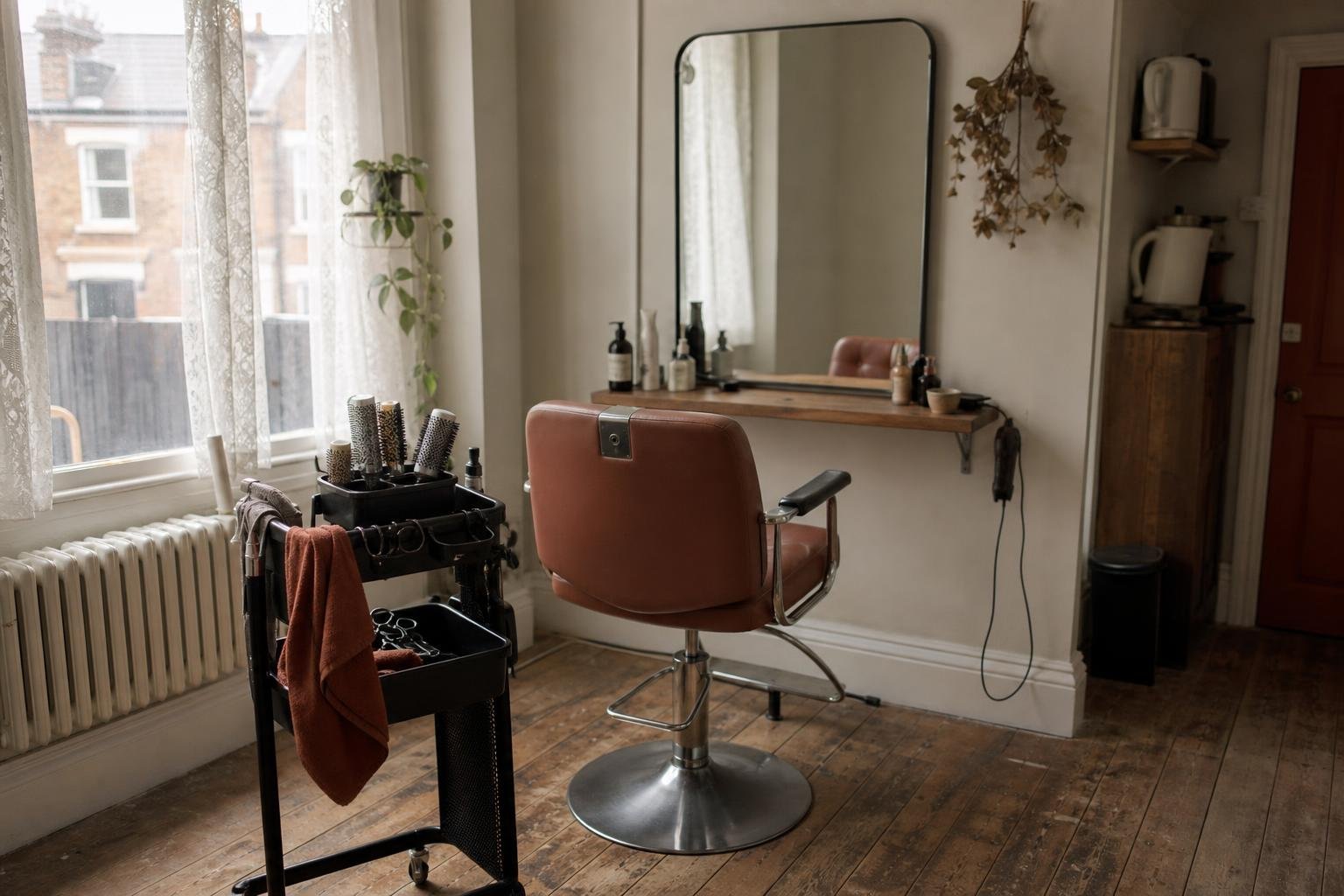
No, you do not have to put your home address on Google, and for most people doing hair from a room at home, hiding it is the setting that fits Google’s own rules. The test Google uses is not whether clients come to your house. It is whether there is a permanent sign with your business name outside it, and most houses do not have one. What you must not do is the trick that gets passed round salon forums: dropping your pin on the main road round the corner so nobody can find the house. That breaks a different rule, and it sends clients to the wrong door.
Why the advice online seems to disagree
Plenty of beauty-business guides tell a home stylist to leave the address blank and set a service area instead. Then you read Google’s own definition, and a service-area business is one that “visits or delivers to customers directly but doesn’t serve customers at their business address”, with cleaners and plumbers as the examples. Your clients come to you. So which is it?
Both are half right, and the piece that joins them is signage. Google’s guidelines for representing your business, read today, say: “Businesses showing their address on Google should maintain permanent fixed signage of their business name at the address.” Its page on service areas goes further, for a business that serves customers at its address and also visits them: “If your business doesn’t have permanent on-site signage, it’s not eligible as a shop front and should be listed as a Service Area Business.”
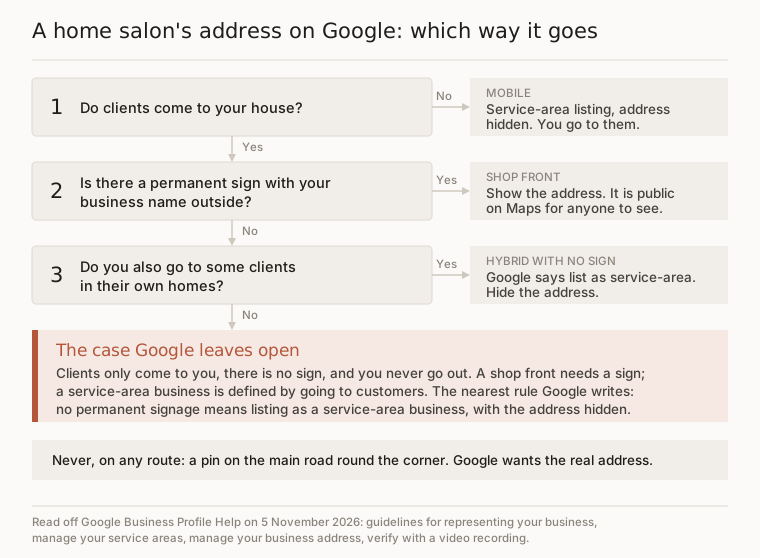
So what decides your listing is the sign, not where clients sit. The figure walks the whole route, including the one case Google’s pages leave open.
If there is a sign: show the address
Some home salons have a proper front: a garden studio with its own gate, or a side door with the business name on a plate. Then you can list as a shop front and show the address.
Three things come with that. The address is public, and Google’s page on managing your address says so in as many words: “The address on your Business Profile is public.” The sign has to be permanent, not a poster in the window. And if Google asks you to verify by video, the shop front version wants your business name “clearly printed on a permanent fixture, like a signboard, wall or window”, plus street signs or building numbers to show where you are.
Before you screw anything to the front of the house, check you are allowed to. GOV.UK’s page on running a business from home says you may need permission from your mortgage provider or landlord, and from your local council if you want to advertise outside your home. The same page warns that home insurance may not cover customers visiting.
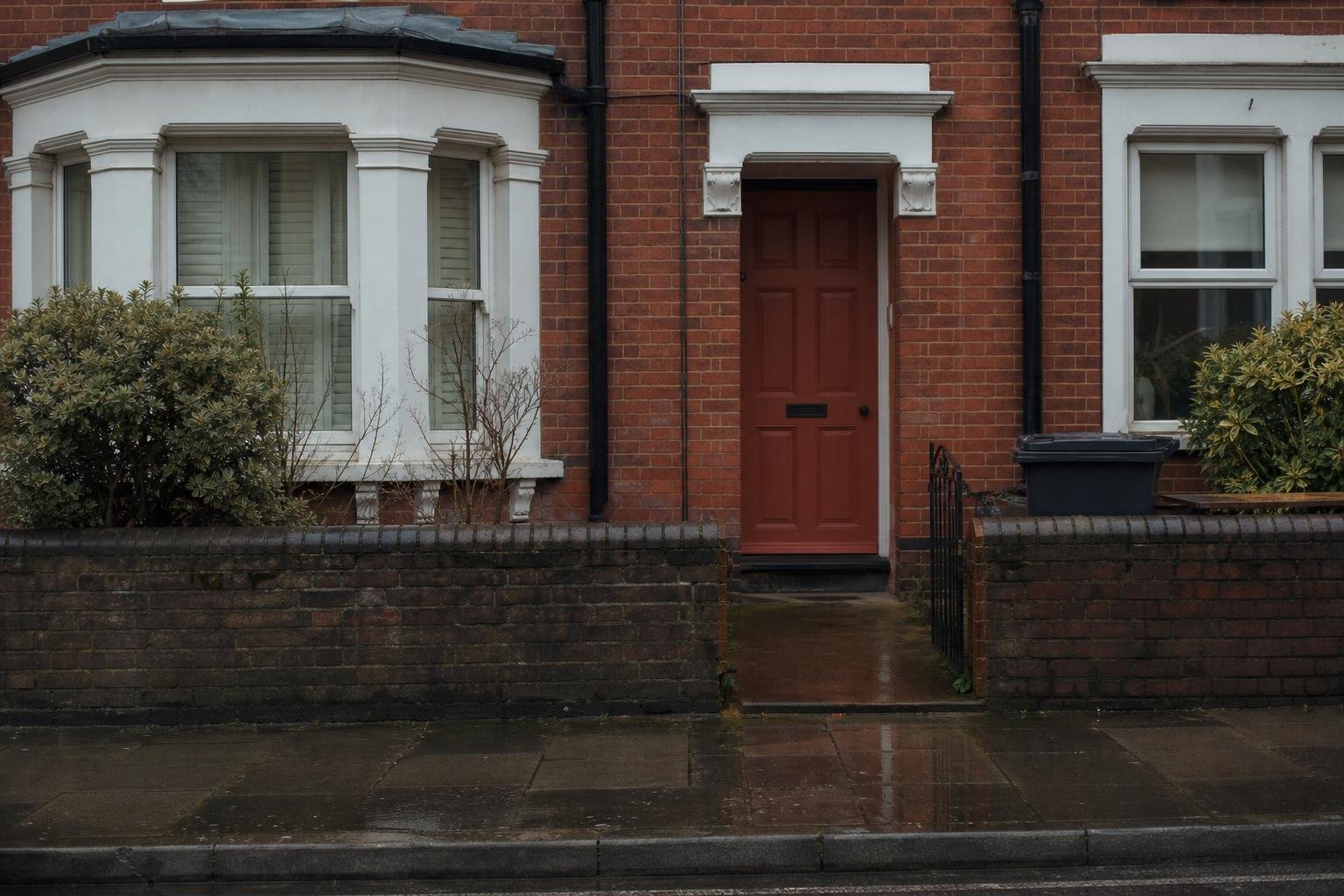
If there is no sign: hide it
This is most home salons, and Google gives you a switch for it. In your Business Profile, go to Edit profile, then Location, then Business location, and turn off “Show business address to customers”. Google’s own note beside that switch is blunt: “You should only choose to not show your address if your business is a service-area business.”
Your profile then shows a service area instead. Pick it yourself, or Google chooses one for you: up to 20 towns or postcodes, not a circle round your house.
Hiding the address does not mean Google does not know it. To verify, Google wants “a business address that Google can find”. If it asks for a video, its page has a tip written for exactly your situation: “If you run a Service Area Business from your home, you can record landmarks and signs in your immediate neighbourhood to verify the address.” Then show your tools, your workspace, your cards, and a document such as an invoice with your business name on it. Keep clients out of shot: the video must not include other people’s faces.
Now the honest edge. If you also go out to some clients (older regulars, a bride on the morning, anyone who cannot get to you) you fit Google’s description of a hybrid business, and the no-sign line quoted above was written for you. If every client comes to your house and you never go out, Google’s pages do not have a box that fits neatly. A shop front wants a sign you do not have, and a service-area business is defined by going to customers. The nearest thing Google writes down is that no-sign line, and it is what most home stylists follow. Know that it is the nearest fit rather than a perfect one, and keep everything else on the listing exact: your real name, your real phone number, the areas you really serve.
Why the pin round the corner is a bad idea
One workaround turns up in old salon forum threads: put the marker on a nearby main street with no house number, so the listing shows an address but not yours. Google’s guidelines close that off. They ask for “a precise, accurate address” and say “Create your Business Profile for your actual, real-world location.” The same guidelines open by saying that a profile which will not be suspended has to reflect your business accurately.
And a client who follows a made-up pin ends up outside somebody else’s house, rings you lost and starts late. Hiding the address protects your privacy without that.
Hiding it on Google is not the same as hiding it
The worry underneath this question is not really Google. It is a stranger knowing where you live and work on your own. The switch only covers your Google listing, and Google says it “determines how best to display your business address based on your business information and information from other sources.” So if your full address sits on your booking page, your Facebook page or your website footer, it is out there whether Google shows it or not. Go through each one and take the house number off anywhere a stranger can read it.
Then decide when a client gets the address: a stranger finds you by area, books, and the full address arrives in her confirmation message, not before. The only people who know your door number are people you have agreed to see. If you trade as a limited company, there is one more public record to check, and it is in the questions below.
Where ads fit, and where they do not yet
We run Google Ads for hairdressers, and we turn away anyone who can only spend under about £100 a month, because below that there is rarely enough money to learn which searches turn into bookings. Plenty of one-chair home salons sit under that line, and for them the free listing, set up properly, is the better first job.
If you are past that line, fixing your Google listing before you pay for ads explains why the listing still comes first. If you mostly travel to clients, getting clients as a mobile hairdresser covers service areas.
Google’s and GOV.UK’s pages quoted here were read on 5 November 2026.
Questions people ask
Should a home salon put opening hours on Google if it only works by appointment?
Google's guidelines, read today, say certain kinds of business should not provide hours, and name those that operate only by appointment among them. If you do keep set days, list the hours you genuinely see clients and answer the phone, and use special hours for holidays so nobody turns up to a locked door.
If I set up a limited company, will my home address end up public anyway?
It can. GOV.UK says, read today, that a company's registered office address is publicly available on the online register, and that if you do not want an address public, for example your home, you should not use it. You can use an accountant's or solicitor's address with their permission, or appoint an agent, but it has to be in place before you register.
Can I list my home salon under my own name?
Yes, if that is the name clients know you by. Google's guidelines, read today, say the name should be the one used consistently on your shopfront, website and stationery and as known to customers. What they do not allow is extra words: service and location details added to a name can get a profile suspended, so not your name plus Hair Salon Leeds unless that is truly what you are called.
How long does a hidden address or a new service area take to show?
Google says profile changes usually show in about 10 minutes but can take up to 30 days, and approved service area edits can take up to 48 hours. Its verification page also says changes to your business details may mean verifying again, so make the change when you have half an hour free to record a video if Google asks for one.
