
Are the ads at the top of Google Maps worth paying for?
No, you do not have to pay to be on Google Maps. The paid results at the top are ads. Everything under them is the free list, and Google’s own page on local ranking says there is no way to request or pay for a better local ranking. So paying buys you a slot above the free results, not a better place among them.
Whether that slot deserves any of £150 to £300 a month is a separate question. For most single-site salons the honest answer is this: do not buy a campaign just for Maps, do let the search ads you already pay for appear there, and fix your free Google listing before either, because every Maps ad sends people straight to it.
What the paid spots on Maps actually are
Google’s guide to advertising in Google Maps, read on 26 October 2026, lists four kinds.
- Promoted pins. Square pins on the map itself, which stand out from the usual round ones. Google says they can appear while someone browses the map, when they search, along the route in directions, and now and then while they are driving.
- Map search ads. Your salon at the top of the results list when someone searches in Maps, sometimes with a pin to match.
- Map suggest ads. Your salon offered as a suggestion while someone is still typing. Google says these show only in the Maps app on a phone.
- Placesheet ads. Ads on the details page of a place someone has tapped, such as a shop shown on its shopping centre’s page.
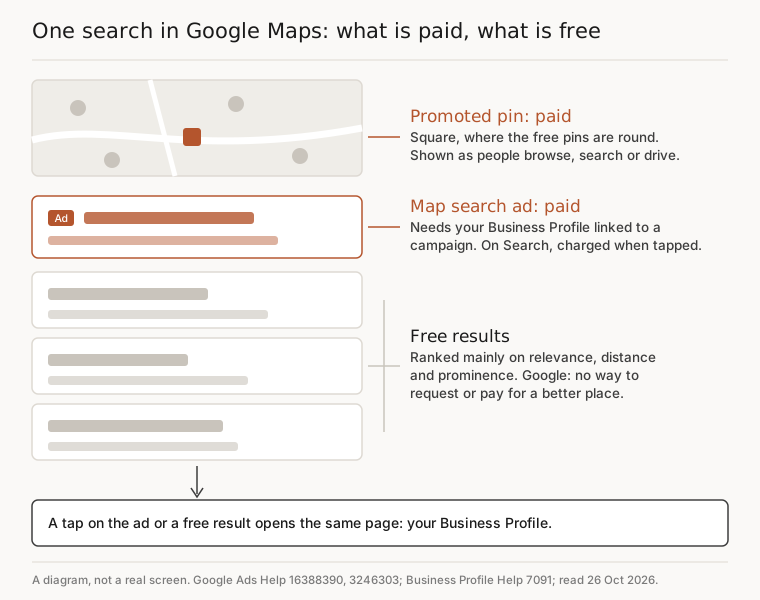
For a salon, the map search ad is the one that matters most, because it only appears when somebody has typed what they want. A pin can catch the same person, but it also catches people who are looking at the map for some other reason entirely, such as finding the car park.
Can you pay for Maps on its own?
This is where Google’s own pages disagree with each other, so here is exactly what they say today.
The Maps guide says, twice, that you currently cannot serve ads only in Google Maps, because the campaigns that use it may serve in several places automatically. Google’s page on showing search ads on Maps carries the same note.
Google’s page on channel controls in Demand Gen campaigns tells a different story. It lists Maps as one of the channels you can tick, alongside YouTube, Gmail, Discover and the display network, and adds that Maps only serves when a location asset is switched on. On the face of it, ticking Maps and nothing else is close to a Maps-only campaign. The page does not say so in as many words, and the older guide says you cannot. We would not plan a month’s budget around either reading.
The bigger point does not depend on which page is right. Google describes Demand Gen as serving across its visual-first surfaces, such as YouTube, Gmail and Discover, and on Maps it shows promoted pins. That is an ad built to be noticed by people moving around, not one that answers somebody typing “balayage near me”. On a small budget, the person typing is the one you want.
The Maps ad a small salon would actually use
If you run an ordinary Search campaign and link your Google Business Profile to it, the same ads can appear in Maps. Google’s Local ads page says that linking the profile is what lets your ads show in local formats across Search and Maps, and the Maps guide says map search ads and map suggest ads both work with Search campaigns.
That is the right shape for £150 to £300 a month. Same searches, same budget, no second campaign to feed. You choose what to appear for, such as colour or a cut in your town, and Google decides whether the ad lands in the search results or in Maps.
Here is what Google’s Maps guide says each campaign type can show there.
| Campaign type | What it can show in Maps |
|---|---|
| Search, with your Business Profile linked | Map search, map suggest and placesheet ads |
| Smart campaign | Promoted pins with an icon for your type of business, plus map search and map suggest ads |
| Performance Max for store goals | Promoted pins with your logo, map search, map suggest and placesheet ads |
| Demand Gen | Promoted pins |
If a Google rep has suggested Performance Max for store goals, the Google rep says switch to Performance Max covers that call. If you are on a Smart campaign now, moving off a Smart campaign without losing your bookings covers the switch.
What you are charged for
On Search and Performance Max, the Local ads page lists the taps you can be charged for: a headline or link that goes to your web page, a headline that opens your Business Profile, the map for driving directions, the Call, Directions or Website buttons, and a pin. Google says you are only charged for one of these, even if the same person taps several. Swiping through the photos in the ad costs nothing.
The exception is the pin with your logo from Performance Max for store goals. On Maps, Google says those campaigns charge per thousand views when people see the pin. That is paying to be seen, including by people who are driving past on their way somewhere else and never tap.
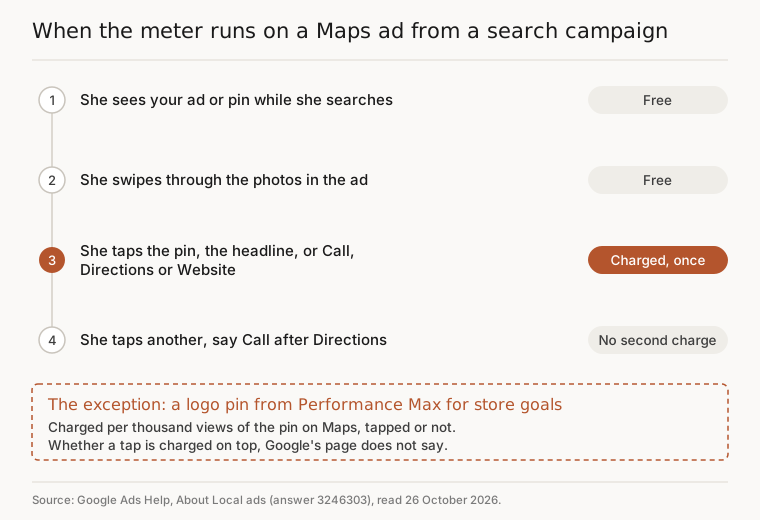
On a small budget that difference matters. Pay per tap and every pound goes on someone who did something. Pay per view and part of it goes on people who glanced at the map and carried on.
Every Maps ad lands on your free listing
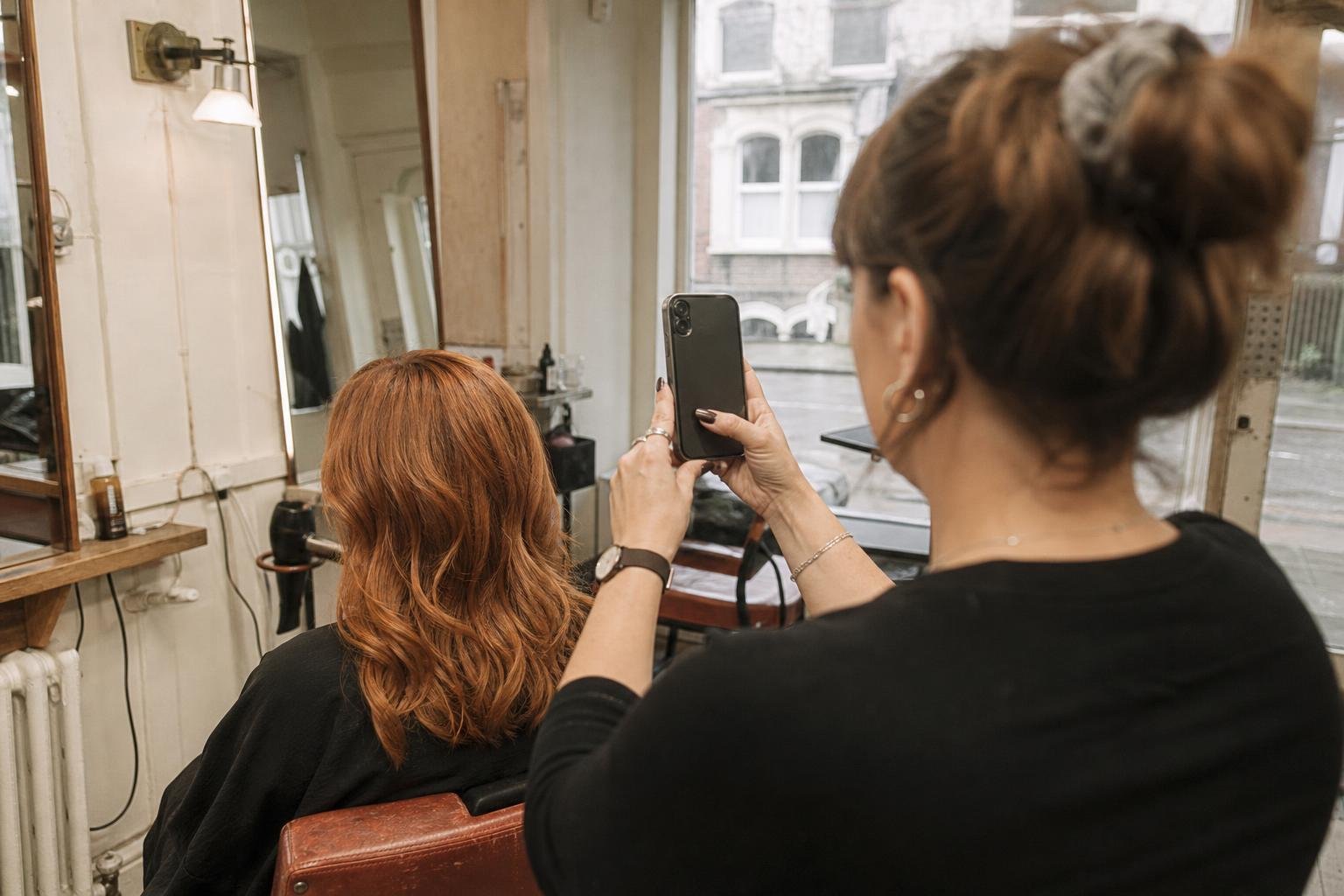
This is the part that decides whether any of it pays. Google’s Local ads page says these ads show your star rating, address, phone number, photos and opening hours, often taken from your linked Business Profile, and one of the taps it charges for is the one that opens that profile. The ad is only as good as the listing behind it. Pay to put a listing with wrong hours, three old photos and unanswered reviews above everyone else, and you have paid to show people a reason to go elsewhere.
The same listing decides where you sit in the free results underneath. Google’s local ranking page says those results are mainly based on relevance, distance and prominence, and that more reviews and positive ratings can help. Its own list of things to do is short and free:
- Verify the business.
- Keep the hours right, including special opening hours over Christmas and bank holidays.
- Choose the right business category.
- Reply to reviews.
- Add photos and videos of your actual work.
Every one of those helps the paid slot and the free list at the same time. If your salon does not appear on Maps at all, start with why your salon does not show up on Google Maps instead.
So should you pay for it?
For a single-site salon on £150 to £300 a month, this is what we would do.
- Fix the listing first. It costs nothing, it moves the free results, and it is the page every Maps ad opens.
- Link the listing to your search campaign, so the ads you already pay for can appear in Maps when someone searches there. You are charged when someone taps, not for being linked.
- Skip a separate pin campaign. Pins bought by the thousand views are built for being seen by passers-by. Your money does more on people who have typed the service you have gaps for.
- Judge it on calls and direction taps, not on how often the pin was shown. The questions at the bottom say where to find those.
If £100 a month is nearer what you have, is a hundred pounds a month enough for Google Ads is honest about what that buys.
Where we stand on this
Read this knowing we sell Google Ads for salons. What we do is one campaign split by service, with 536 time-wasting searches blocked before your first click, a landing page on our domain, and your Google listing fixed before you pay us anything. Then four numbers and one email a month. It is £15 to £149 a month depending on what you spend on ads, no commission on bookings ever, and you can cancel in one click.
Our one named result so far is Rachel Hartley at The Lockhouse, on £300 a month, who says it got her eight colour clients in the first month. That is one salon, and it is not yours. If you want to see what your own empty chairs are costing you, the calculator on our homepage asks for your business type, your chairs and how your week usually goes, and shows you the figure for a year before you have an account or hand over a card.
Questions people ask
Why can I not see my own ad when I look on Google Maps?
Google's Maps advertising guide lists the usual causes: your Business Profile is not linked and verified, the location asset is not active and approved, the campaign is paused or aimed at the wrong area, the search does not match your keywords, or another ad won the slot. For pins, zoom in, because Google says promoted pins do not show when the map is zoomed out.
Where do I see how many people tapped my ad in Maps?
In Google Ads, open your campaigns, ad groups, ads or keywords, click the Segment icon and choose Click type. Google's page on search ads in Maps says this splits out taps that expand your details from the results list, taps for directions and taps to call from a phone. Direction taps are the closest thing to someone heading for your door.
Can I advertise on Maps if I am a mobile hairdresser with no salon?
Yes, in principle. Google's Local ads page says these ads are for businesses with a physical location or a service area, and its page on search ads in Maps says a business that goes to its customers, with no shop front, should set its Business Profile up as a service area business. Get that profile right before spending anything on ads.
Can I stop the ad showing the photos from my Google listing?
Yes. Google's Local ads page says the ads on Search pull photos and videos from your Business Profile as well as images you add in Google Ads, and that you can opt out of the profile photos if you only want your campaign's own images. It also warns that this could hurt how the ad performs, so replacing weak photos on the listing is usually the better fix.
Will my salon's ads show on Waze as well?
Not in the UK, as things stand. Google's Local ads page marks Waze ads as US only, and says they currently run only through Performance Max for store goals campaigns bidding on shop visits, shop sales or directions. A UK salon running an ordinary search campaign will not appear there.
