
Another salon is bidding on your salon's name

Yes, they can. Google lets any advertiser choose another business’s name as a keyword, so a salon down the road can pay to have its ad appear when somebody searches for yours. What it generally cannot do is put your name in the words of the ad, and even that is only something Google acts on if you hold trade mark rights and complain. Whether you should pay to push their ad down is a separate question. On £150 to £300 a month, the honest answer is usually not yet, and this piece shows you how to tell.
What Google lets them do
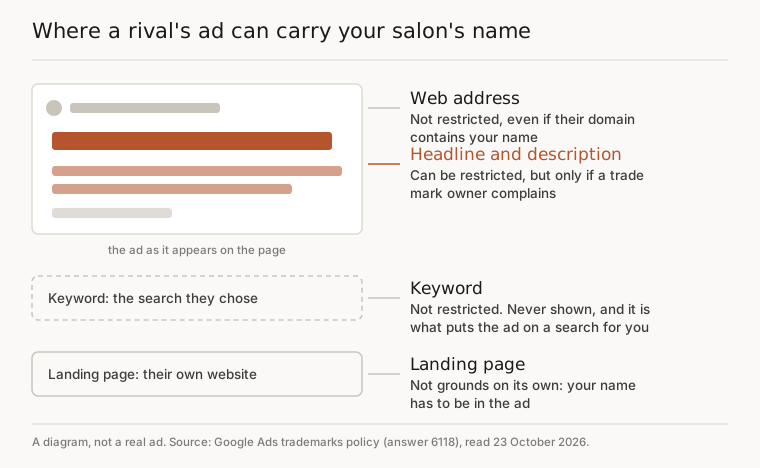
Google’s trademarks policy, read on 23 October 2026, is short and plain. It says Google will not restrict trademarks used as keywords. So the other salon can pick your salon’s name as a search to show up on, and nothing in Google’s rules stops it.
It also says Google will not restrict a trademark in the second-level domain of the ad’s web address, which is the name part before .co.uk. And the trademark has to be used in the ad itself, not only on the page the ad leads to.
What Google says it will restrict, once a trade mark owner complains, is a trademark used in an ad from a direct competitor, and ads that use it in a confusing, deceptive or misleading way. For a salon, that means the headline and the description. An ad with your salon’s name written in it is the part you can do something about.
It is also being sold as a tactic. One salon Google Ads guide we read today tells salons to bid on rival salons’ names and calls it “a common and accepted practice”. If it is happening to you, it is probably on purpose. If a new salon has just opened near you, when a new salon opens on your street covers the rest of that situation.
The one thing you can report, and the catch
Google’s policy says it only accepts complaints against specific advertisers, identified by their web address, and only in the countries and industries where the owner has shown trade mark rights. Google’s report form asks whether you have trademark rights information that establishes you as the owner.
For most independent salons that is where it stops, because most have never registered their name. GOV.UK’s trade mark page, read today, says registering costs at least £205, usually takes around 3 to 4 months from application if there are no problems, and lasts 10 years before it has to be renewed.
So the deal is this. At least £205 and a few months’ wait, and at the end of it Google can stop the rival writing your name in their ad. It still cannot stop them appearing on searches for your name, because keywords are not restricted. If their ad already leaves your name out of the wording, a trade mark changes nothing about what you are seeing.
Registering your name can be worth doing for other reasons. That is a question for a solicitor or the Intellectual Property Office, not for us.

Find out how often it actually happens
Before you spend a penny, look. Search your salon’s name on your phone, from the salon and from home, at a few different times of day. Google’s Ad Rank page says each auction takes in the context of the search, including where the person is, what device they are on and the time. One search tells you very little. An ad that turns up once on a Tuesday morning is not the same as one sitting above you every time.
Look, but do not tap it. That is in the questions at the bottom.
Then check how many people search for you in the first place. The performance page of your Google Business Profile shows, in Google’s words, the search terms people used to find your business, updated at the start of each month. See whether your salon’s name is one of them and how high up the list it sits.
If you already run ads, the auction insights report lists other advertisers taking part in the same auctions as you. Google says it shows nothing when your ad appeared on less than 10% of the searches it was eligible for, so a very small campaign may see a blank report.
Who is really at risk
Think about who types your salon’s name into Google. Most of them already know you. A regular checking what time you open. Someone who has lost your number. They are not going to book a colour with a stranger because an ad sat above you for a second.
The person at risk is the one a friend told about you, looking you up for the first time. She has not decided yet. She is the new client word of mouth was about to hand you, and the rival’s ad is aimed at exactly her.
Here is the trouble with paying to defend. You cannot buy an ad that only shows to her. An ad on your own name shows to everyone who searches it, and you pay whenever any of them taps it, regulars included. Those regulars would have found you through your free listing anyway.
These numbers are made up, so put your own in. Say 80 people a month search for your salon’s name. Say half of them tap your ad rather than your free listing, and a click on your own name costs £1. That is £40 a month, more than a quarter of a £150 budget, leaving £110 for everything else, and most of it goes on people who were already yours. How many of the 80 would the rival have taken? Nobody can tell you that number, and Google does not report it.
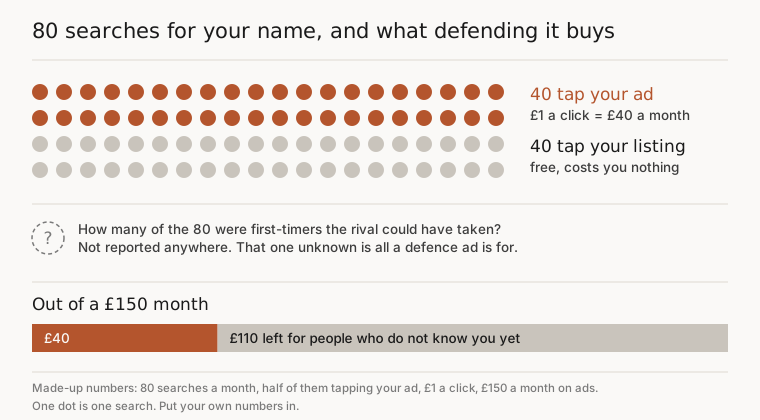
That is also why ads on your own name make any campaign look good. Those clicks book well, because they were coming anyway. If you pay someone to run your ads, it is worth knowing how much of what they report is your own name. What a new client should actually cost you goes through counting only the people who are new.
When defending your name is worth it
It earns its money in a few cases:
- The rival’s ad sits above you nearly every time you look, from more than one place, not once in a while.
- New clients tell you they nearly went elsewhere. Ask every new face how she found you. If more than one says she saw another salon when she looked you up, that is the first-timer you are losing.
- Their ad is written to confuse, so somebody could think it is you. That is worth reporting if you have trade mark rights, and worth defending against if you do not.
If it is, keep it small and give it an end date. One ad on your exact salon name and nothing else, a small daily budget, a month, then look at what it spent, how many calls and booking clicks it got, and whether new names turned up in your book. Google’s Ad Rank page says the quality and relevance of your ad and the page it leads to count alongside the bid. On a search for your own name, no page is more relevant than yours, so you may not need to outbid them, only to turn up.
Two free things come first.
- Get your Google listing right. On a search for your name, your Business Profile is what should fill the screen, with your hours, photos and reviews. If it does not appear at all, start with why your salon does not show up on Google Maps.
- Have a word. It is a high street, not a war. You can simply agree with them not to bid on each other’s names, and a polite conversation costs nothing.

Where we stand on this
Read this knowing we sell Google Ads for salons. Our starting view is the one in this piece: your budget belongs on searches from people who do not know you yet, like a colour or a cut in your town, in the hours you have gaps. If £100 a month is about what you have, is a hundred pounds a month enough for Google Ads is honest about what it buys.
What we do is one campaign split by service, 536 time-wasting searches blocked before your first click, a landing page on our domain, and your Google listing fixed before you pay anything. Then four numbers and one email a month. It is £15 to £149 a month depending on what you spend on ads, no commission on bookings ever, and you can cancel in one click.
Our one named result is Rachel Hartley at The Lockhouse, on £300 a month, who says it got her eight colour clients in the first month. That is one salon, and it is not yours. The free assessment takes about forty seconds and shows you your own local search numbers and what is wrong with your Google listing, before you have an account or hand over a card.
Questions people ask
Can I bid on the other salon's name back?
Yes. The same Google policy applies to you: it does not restrict another business's name used as a keyword. What you should not do is put their name in the words of your ad, because if they hold trade mark rights and complain, Google can restrict that. Bear in mind that people searching a rival's name were looking for them, not you.
Should I click their ad to use up their budget?
No. Google counts manual clicks made to increase someone's ad costs as invalid clicks, and its help page says advertisers are not charged for invalid clicks, which are filtered out of their figures and their bill. So it costs them nothing, it gets you nothing, and it wastes the time you could spend on your own listing.
If Google upholds a complaint, will they just change the ad and carry on?
Google's trademarks policy says that when it restricts a trademark after a complaint, the restriction is generally applied on an ongoing basis to any ads that use the same second-level domain in their final URL. In plain terms, it follows the rival's web address, so rewording one ad does not get round it.
Can the other salon get banned from Google Ads for this?
Not straight away. Google's trademarks policy says a breach of that policy will not lead to an immediate account suspension without warning, and that a warning is issued at least 7 days before any suspension. Most of what a rival salon does with your name is allowed anyway, so expect an ad to be restricted rather than an account to be closed.
Does a UK trade mark cover my salon in Ireland or abroad?
No. GOV.UK says registering a trade mark in the UK only protects your brand in the UK and the Isle of Man, with separate processes for Guernsey, Jersey and other countries. Google's policy also says it accepts complaints only within the countries where the owner has shown trade mark rights, so a UK registration is what counts for ads shown here.
